

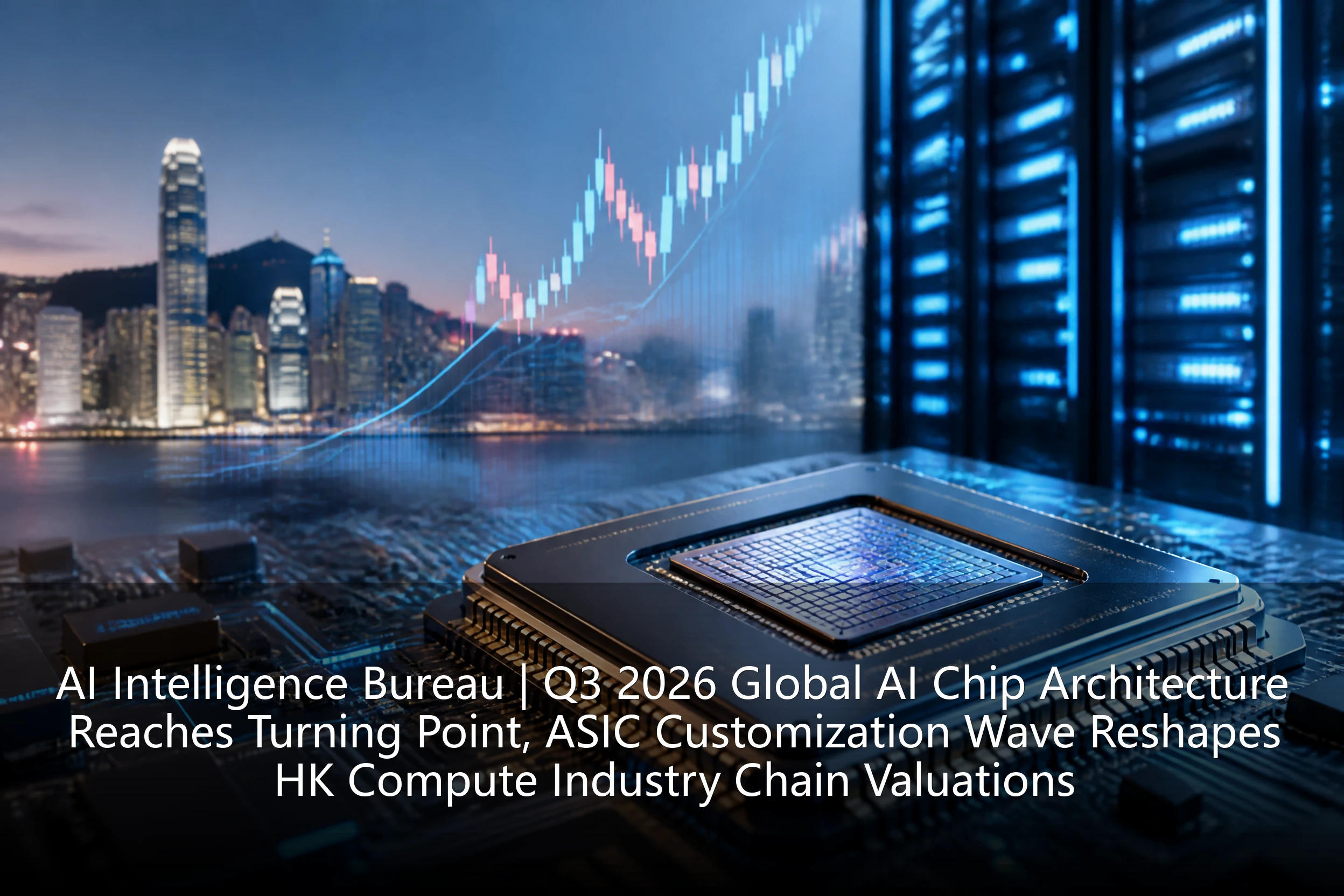
In August 2026, the global artificial intelligence industry is quietly undergoing a profound transformation in underlying hardware architecture. If the past three years were the golden age where general-purpose GPU giants like Nvidia dominated by leveraging large model training demands, now, as AI applications fully transition from the "wild growth" pre-training stage to the "budget-conscious" inference implementation phase, the demand structure of the compute market is undergoing a fundamental reversal. General-purpose GPUs increasingly expose shortcomings in power consumption and cost-effectiveness when handling specific high-frequency inference tasks, while Application-Specific Integrated Circuits (ASICs), with their advantages tailored for specific AI algorithms, are reaching a historic developmental turning point.
As an independent market commentator at Huagang Zhishi, the author has keenly observed in recent market recaps that global tech giants are quietly adjusting their compute infrastructure strategies. The wave of chip architecture evolution from general-purpose to application-specific not only breaks the original compute oligopoly pattern but also triggers a deep value revaluation of the chip design, advanced packaging, and edge compute industry chain in the HK stock market. This article will deeply analyze this ongoing compute revolution from three dimensions: architectural turning points, industry chain restructuring, and HK stock investment opportunities.
1. Q3 2026 Compute Architecture Turning Point Confirmed: From "Extensive Training" to "Intensive Inference"
Reviewing the evolution history of the AI industry, every iteration of underlying hardware architecture is essentially to solve the compute bottlenecks of specific developmental stages. During the large model "arms race" period from 2023 to 2025, tech giants pursued extreme expansion of parameter scales, with a demand for compute that prioritized "absolute performance." At that time, GPUs with highly parallel computing capabilities and versatility became the only choice, creating Nvidia's myth in the capital markets.
However, entering the second half of 2026, the industry logic has fundamentally shifted. The marginal returns brought by the expansion of large model parameter scales are diminishing. Leading manufacturers like OpenAI and Google have explicitly shifted their strategic focus from "training larger models" to "making existing models run cheaper and faster." Against this backdrop, the structure of compute consumption is drastically tilting from the training side to the inference side. According to general industry estimates, the global AI inference compute demand accounted for more than 60% of total compute expenditure in 2026, surpassing training demand for the first time.
General-purpose GPUs, designed to balance multiple tasks like graphics rendering and scientific computing, contain many redundant logic control units. This leads to severe energy waste and low compute utilization when executing highly deterministic AI inference tasks. In contrast, ASIC chips, by removing unnecessary general-purpose computing modules and dedicating all transistor resources to specific neural network operators (like matrix multiplication and attention mechanism calculations), typically achieve energy efficiency ratios (TOPS/W) in specific inference scenarios that are several to over ten times higher than general-purpose GPUs.
This underlying physical advantage translates directly into massive commercial economic benefits today, as inference demand explodes. When tech giants' data center electricity bills are calculated in billions of dollars, the ultimate energy efficiency of ASICs is no longer an optional icing on the cake, but a "cost-reduction weapon" vital for corporate survival. Therefore, in Q3 2026, we witnessed the confirmed turning point of ASIC chips transitioning from "niche customization" to "mainstream standard."
2. Deep Restructuring of the Industry Chain: Three Dimensions of the ASIC Customization Wave
The rise of the ASIC customization wave is not a simple replacement of a single chip product, but a reshaping of the entire semiconductor industry chain ecosystem. From IP licensing, chip design, wafer manufacturing to advanced packaging, the industrial value chain is undergoing a profound redistribution of interests.
1. Chip Design Phase: From "Buying Off-the-Shelf" to "Joint Definition"
In the past, cloud providers could meet their needs by purchasing standardized GPU products. In the ASIC era, because deep customization is required for specific business scenarios (like recommendation systems, search ranking, and large language model API calls), cloud providers must deeply intervene in the chip definition phase. This has spawned two core beneficiaries: first, third-party IC design service companies with strong architectural design capabilities, which assist cloud providers in completing the cross-domain translation from algorithms to RTL code; second, licensing vendors holding core AI chip IPs (such as NPU interfaces and on-chip interconnect architectures). In the HK stock market, semiconductor enterprises deeply engaged in Data Processor Unit (DPU) and customized accelerator design are experiencing an order explosion.
2. Advanced Packaging Phase: The "Hidden Winner" of the ASIC Boom
To achieve ultimate performance, ASIC chips typically adopt a multi-die integrated Chiplet architecture. This approach of "assembling" small chips with different functions together via 2.5D or 3D packaging technology greatly alleviates the pressure from single-chip process bottlenecks, while also placing extremely high demands on advanced packaging capacity. TSMC's CoWoS process is undoubtedly the industry benchmark, but its capacity has long been in short supply. This leaves huge domestic substitution space for second-tier foundries with advanced packaging capabilities, as well as supply chain enterprises providing bonding equipment and substrate materials. Targets in the HK stock market involving semiconductor packaging, testing, and core materials are gradually entering the视野 of institutional funds.
3. Edge Compute Networks: The "Capillary Revolution" Triggered by ASIC Penetration
Beyond cloud data centers, another major battlefield for ASICs lies on the edge side. With the comprehensive popularization of AI smartphones, AI PCs, autonomous driving, and industrial robots, compute demand is penetrating from the cloud to edge nodes like "capillaries." Edge devices are extremely sensitive to power consumption, size, and cost, making ASICs the only viable hardware carrier. This drives a surge in shipments of edge-side AI SoC chips and also promotes the development of edge compute network management platforms. In the HK stock market, hard-tech enterprises that have提前布局 in IoT chips and smart cockpit SoCs are expected to achieve a dual leap in performance and valuation in this wave of edge compute penetration.
3. Prospects and Independent Judgments on Valuation Leap Opportunities in the HK Compute Industry Chain
As a financial observation platform focusing on the HK and A-share markets, Huagang Zhishi always emphasizes finding the intersection of macro industry trends and capital market pricing mismatches. The valuation reshaping of related HK industry chains by the ASIC customization wave is not a short-term thematic speculation, but a medium-to-long-term logical evolution based on fundamental performance support.
From market sentiment and capital flows, the HK tech sector in mid-2026 is in the deep water zone of valuation repair. Previously suppressed by external geopolitical games and macro liquidity tightening, the overall valuation of HK semiconductor and compute sectors was at a relatively historical low. However, with the substantive landing of ASIC orders and the better-than-expected release of related enterprises' interim report performance, institutional funds are making forward-looking position adjustments.
1. Seeking "Certainty Premium"
In the ASIC industry chain, the link with the highest certainty is not the chip design companies directly competing with cloud giants, but the "water sellers" providing underlying IP licensing and advanced packaging services. These companies, by virtue of extremely high technical barriers and asset-light business models, can enjoy higher valuation premiums. Investors should focus on hidden champions in the HK market with core patents in high-speed SerDes interface IPs and Chiplet interconnect standards.
2. Beware of the "Pseudo-ASIC" Concept Trap
During periods of high market sentiment, it is inevitable that listed companies will jump on the concept bandwagon. True ASIC customization logic requires enterprises to have profound underlying architectural design capabilities and deeply bound ecological relationships with leading algorithm vendors. Some enterprises that can only provide low-end standardized chip packaging services have no strong correlation between their performance growth logic and the AI compute explosion. Investors need to carefully discern the composition of enterprises' R&D expenses and the true quality of their top five clients to avoid falling into the thematic trap of "pseudo-ASICs."
3. Focus on the Edge Compute "Scissors Gap" Opportunity
Compared to the high concentration of cloud computing, the edge compute market landscape is more fragmented, but it also implies greater growth elasticity. Especially as the intelligent penetration rate of domestic new energy vehicles breaks through the critical point in 2026, the demand for in-vehicle AI inference chips shows exponential growth. Semiconductor companies in the HK stock market with mass production experience in automotive-grade ASICs are expected to usher in a "scissors gap" explosion in performance within the next 1-2 years.
4. Conclusion: Finding Investment Anchors Amidst Compute Architecture Transitions
Historical experience shows that every generational iteration of computing architecture breeds new tech giants while eliminating old forces that fail to turn around in time. The ASIC customization wave initiated in Q3 2026 is precisely the historic transition of AI compute from general-purpose to application-specific. This is not only a technological revolution about transistor arrangement optimization but also a commercial revolution reshaping the interest distribution of a hundred-billion-level semiconductor industry chain.
For the HK stock market, this is both a strong catalyst for valuation repair in the tech sector and an important opportunity for investors to re-examine the value of hard-tech assets. Amidst the ups and downs of market sentiment, maintaining independent and objective judgments, seeing through the concept fog, and anchoring those core assets of the compute industry chain that truly possess core technical barriers and performance realization capabilities will be the key to obtaining excess returns in the coming period. Huagang Zhishi will continue to track the evolution of this industry trend, providing investors with the most cutting-edge market insights and in-depth recaps.