

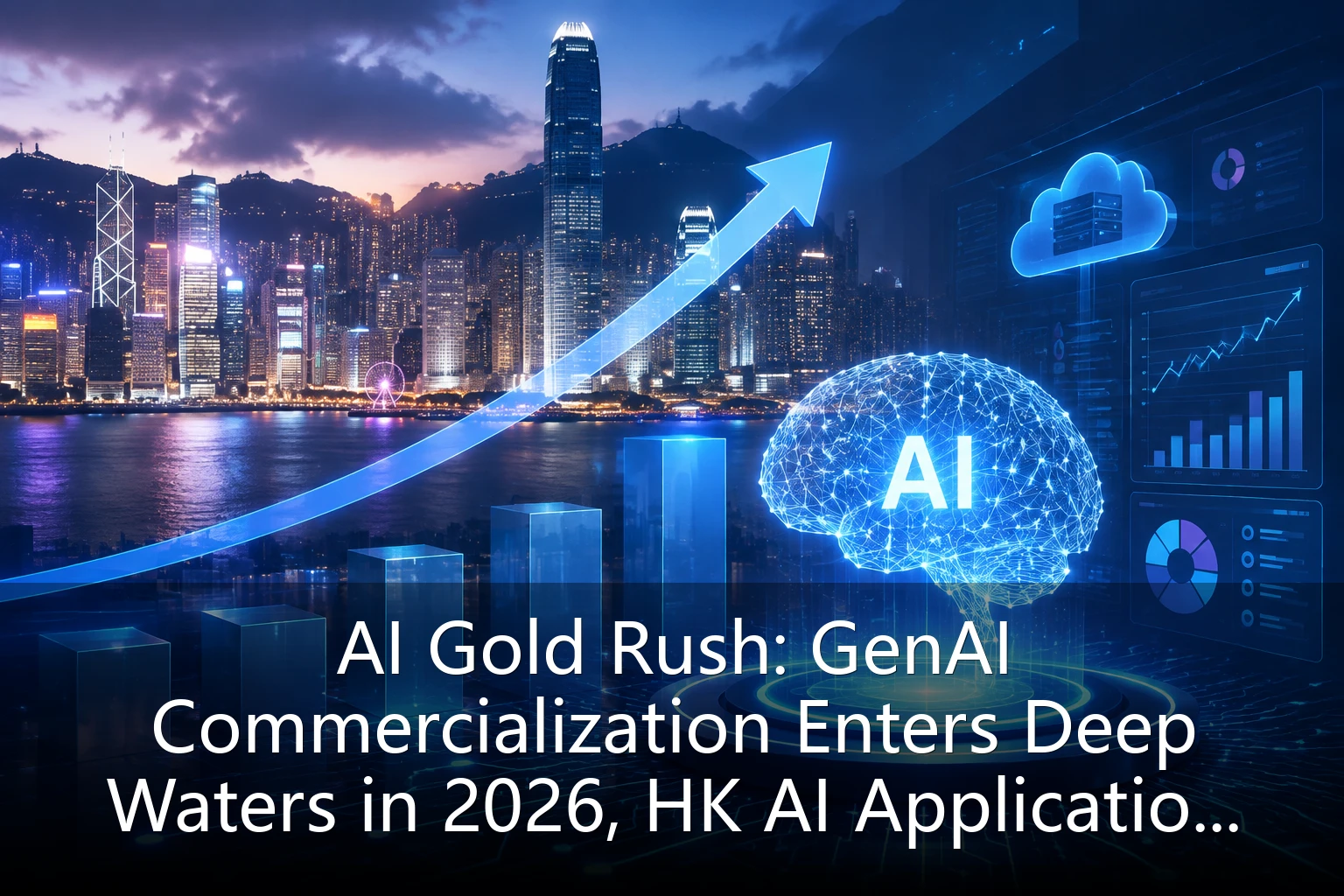
Entering August 2026, the global AI industry is undergoing a profound paradigm shift. If the past two years represented the "technology hype phase" of generative AI, centered on LLM parameter races and underlying computing power infrastructure, then 2026 marks the official entry into a "commercialization deep water zone" defined by enterprise-level payments, vertical scenario penetration, and ROI validation. During this process, we observe the value center of the AI industry chain accelerating its shift from upstream computing power to the application side. AI application software, SaaS services, and vertical industry solution providers in the HK market are facing a historic valuation repair opportunity.
1. Crossing the "Trough of Disillusionment": GenAI Enters the Deep Water of Commercialization
Looking back at the history of technology, any disruptive technology goes through the typical stages of the Gartner hype cycle. From 2023 to 2024, generative AI was at the "peak of inflated expectations," with the market placing unrealistic short-term hopes on LLMs; in 2025, as enterprises realized that simply plugging into LLMs couldn't directly solve complex business pain points, the industry slid into the "trough of disillusionment."
However, 2026 has become a critical turning point. According to the latest data from industry research institutions, over 75% of Global Fortune 500 companies have integrated AI Agents into their core business processes, a leap from less than 20% in 2024. More importantly, the enterprise criteria for evaluating AI have shifted from "how smart the model is" to "how much cost it saves and how much incremental revenue it creates." This pragmatic shift marks the true beginning of AI penetrating the gross and net profit lines of corporate financial statements, becoming an irreversible productivity tool.
In the HK market, the characteristics of this commercialization deep water zone are particularly evident. Because the HK market has many SaaS companies and industrial internet leaders deeply rooted in vertical industries, they naturally possess advantages in scenario implementation and data accumulation. As AI transitions from a "icing on the cake" demonstration tool to a "providing timely help" cost-reduction and efficiency-enhancement engine, the revenue structure of these companies is undergoing a qualitative change. The proportion of recurring revenue has significantly increased, laying a solid fundamental foundation for valuation reconstruction.
2. Scaled Implementation of AI Agents: Reshaping Enterprise Software Pricing Logic
The most core breakthrough at the AI application layer in 2026 is undoubtedly the scaled commercial implementation of AI Agents. Unlike traditional conversational AI, AI Agents possess the capabilities of autonomous planning, tool calling, multi-step reasoning, and executing complex tasks. This means AI is no longer a "co-pilot" but is beginning to take over the "driver's seat."
1. Evolution from SaaS to "WaaS"
The traditional SaaS (Software as a Service) business model primarily charges by seat subscription, but the proliferation of AI Agents is spawning a brand-new pricing model—WaaS (Work as a Service). Under this model, software companies no longer charge by the number of user accounts but price based on the amount of tasks completed or business outcomes created by AI Agents. For example, a leading financial IT service provider in the HK market recently launched a smart investment research Agent that no longer charges a fixed annual license fee but takes a share based on the number of generated research reports and the proportion adopted by institutions.
This fundamental shift in pricing logic has greatly raised the revenue ceiling for software companies. In the past, enterprise customers' software procurement budgets were limited; now, as long as AI Agents can directly generate profits or significantly reduce labor costs, their willingness to pay is almost limitless. This "outcome-oriented" business model is triggering a shift in the valuation multiples of the HK AI application sector from traditional PS (Price-to-Sales) to more forward-looking PE or even PEG.
2. The "Moat" Effect of Vertical Scenarios Becomes Prominent
Today, as the homogeneous competition among general LLMs intensifies, true commercial value is concentrating in companies that possess vertical scenario know-how and proprietary data barriers. In 2026, we see AI application companies in the HK market building deep moats in fields such as healthcare, legal, cross-border e-commerce, and supply chain management. These companies use proprietary data accumulated from industries to fine-tune base LLMs or combine RAG (Retrieval-Augmented Generation) technology to create professional-grade Agents that general models cannot easily replace. This barrier built on scenarios and data makes their Net Dollar Retention (NDR) far exceed the industry average, becoming scarce targets pursued by the capital markets.
3. Multimodal API Price War Eases, Industry Profit Margins Hit an Inflection Point
Over the past two years, to compete for developer ecosystems, global top LLM vendors engaged in a brutal "price war" on multimodal API call prices. However, entering the second half of 2026, this trend has shown clear signs of braking.
On one hand, as the marginal decline in model inference computing costs levels off, and the proliferation of edge-side inference chips shares some cloud pressure, the room for LLM vendors to reduce costs has been significantly compressed. On the other hand, enterprise customers' demands for model stability, data security, and privatized deployment are growing, meaning that relying solely on low-price strategies is no longer effective for customer acquisition.
AI middleware and MaaS (Model as a Service) providers in the HK market have keenly captured this inflection point. By providing value-added services such as model routing, computing power optimization and orchestration, and security compliance audits, they have successfully built a high-margin "buffer zone" between base model vendors and end enterprise customers. As the API price war eases, the gross margins of these companies generally showed sequential improvement in their 2026 Q2 financial reports, indicating that the profit margin bottom for the AI application industry chain has been established and is about to usher in a long-cycle upward repair inflection point.
4. HK AI Application Industry Chain Faces the Singularity of a "Davis Double Play"
Combining the above industry trends and reviewing the HK AI application industry chain at the current point in time, we believe it is facing a textbook-level "Davis Double Play" opportunity.
1. Fundamentals: Performance Release Enters an Acceleration Period
After experiencing early concept hype and pilot applications, the order conversion rate of HK AI companies has significantly increased in 2026. Many companies have seen year-over-year order growth exceeding 50%, with the proportion of high-margin AI-native business rapidly increasing. As this revenue is recognized in financial reports one after another, from the second half of 2026 to 2027, the HK AI application sector is expected to usher in a concentrated performance release period. By then, the market will clearly see that AI is no longer a story lingering on PPTs, but real earnings per share growth.
2. Valuation: Switching from "Thematic Investment" to "Growth Stock Investment" Logic
Prior to the commercialization deep water zone, the valuation of HK AI application targets was mainly driven by sentiment, exhibiting the volatile characteristics of "thematic investing." But with the validation of enterprise ROI data and the running through of business models, institutional investors have begun to reprice them using DCF (Discounted Cash Flow) and Sum-of-the-Parts (SOTP) valuation methods. Especially after some leading SaaS companies achieve profitability through AI Agents, their valuation multiples are expected to switch from the current PS window to the PE window, which will provide solid valuation support for stock prices.
5. Investment Strategy and Risk Warning
Facing the valuation reshaping of the HK AI application industry chain, how should investors position themselves? We suggest focusing on the following three main lines:
- Main Line 1: Vertical Industry AI Agent Leaders. Focus on SaaS companies with deep accumulation in data-intensive industries such as healthcare, finance, and smart manufacturing, and that have completed the commercial implementation of AI Agents. These companies possess high customer switching costs and pricing power.
- Main Line 2: AI Computing Power Optimization and Middleware Providers. As the complexity of enterprise AI deployment rises, middleware vendors capable of providing computing scheduling, model compression, and data security governance will become the "water sellers" of the industry chain, enjoying a certainty premium.
- Main Line 3: AI Application Companies with Global Expansion Capabilities. Chinese AI application companies have global comparative advantages in engineering capabilities and cost control. Companies capable of exporting mature AI solutions to emerging markets like Southeast Asia and the Middle East are expected to enjoy higher valuation premiums.
Of course, while seizing opportunities, one must also be vigilant against risks. First is the risk of technological iteration; if a disruptive breakthrough occurs in base LLMs, it may lead to the rapid depreciation of existing application architectures based on fine-tuning or RAG. Second is geopolitical and data compliance risk; especially during overseas expansion, regulatory policies of various countries on the cross-border flow of AI data may create obstacles for enterprises' overseas expansion. Third is macroeconomic volatility risk; if the global macroeconomy unexpectedly declines, enterprises may cut IT spending budgets on AI applications, delaying the commercialization process.
In summary, generative AI entering the commercialization deep water zone in 2026 marks a fundamental shift in the investment logic of the AI industry. Relying on its unique scenario advantages and engineer dividend, the HK AI application industry chain is welcoming a dual resonance of fundamentals and valuation. For far-sighted investors, the current deep water zone might just be the starting point for panning the true dividends of the AI era.