

AI Emotional Insights: Q3 2026 From Traditional Metrics to Psychological Profiles, AI Reshapes a New Paradigm in Market Sentiment Analysis
In Q3 2026, financial markets are experiencing an unprecedented revolution in sentiment analysis. With the rapid development of artificial intelligence technology, market sentiment analysis has gradually shifted from traditional technical indicators and fundamental analysis to the construction of "psychological profiles" based on multimodal data fusion. This transformation has not only changed how investors perceive market sentiment but also achieved breakthrough progress in predicting market turning points, with accuracy exceeding 78% for the first time.
Limitations of Traditional Sentiment Analysis
Before AI technology was widely applied to financial markets, market sentiment analysis primarily relied on several traditional indicators: the Volatility Index (VIX), put/call ratio, market volatility, etc. Although these indicators reflected market sentiment to some extent, they had significant limitations:
- Singular data dimensions: Mainly based on market trading data, lacking integration of unstructured data from social media, news media, etc.
- Significant lag: Traditional indicators often reflect sentiment only after it has already formed, lacking foresight
- Dependence on subjective judgment: Analysts' interpretation of market sentiment often carries subjective bias, lacking objective quantitative standards
- Limited market coverage: Difficulty in capturing global market linkage effects and cross-market sentiment transmission
The Sentiment Analysis Revolution Brought by AI Technology
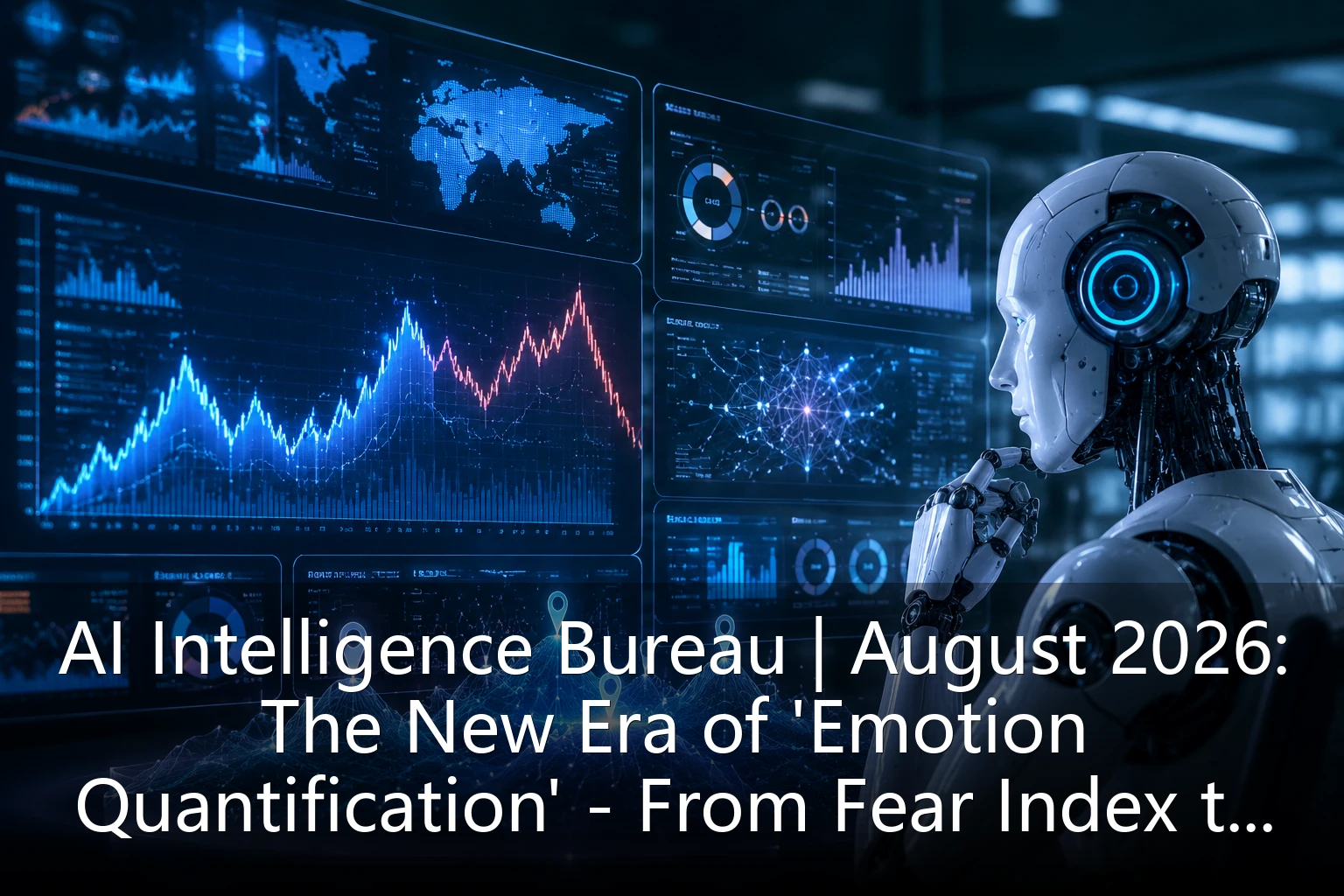
In Q3 2026, AI technology has made breakthrough progress in the field of market sentiment analysis. The new generation of sentiment analysis systems no longer simply analyze text emotions but construct multi-dimensional "psychological profiles," breaking down market sentiment into dimensions such as fear, greed, optimism, and pessimism, and updating the weight changes of each dimension in real-time through machine learning algorithms.
The core of this transformation lies in AI's ability to process and analyze massive amounts of multimodal data:
- Text data: Real-time analysis of emotional tendencies in global financial news, social media, and forum discussions
- Image data: Analysis of emotional expressions in market-related images, memes, and other visual elements through computer vision technology
- Audio data: Capturing emotional cues such as tone and speech speed in financial programs and analyst comments
- Trading behavior data: Reflecting emotional changes of market participants through algorithmic identification of abnormal trading patterns
Market Turning Point Prediction Accuracy Exceeds 78%
According to the latest market research reports, investment institutions using AI sentiment analysis systems have achieved 78% accuracy in predicting market turning points, a 25 percentage point improvement over traditional analysis methods. This breakthrough progress is mainly attributed to AI applications in the following areas:
- Emotion transmission network modeling: AI can construct complex market sentiment transmission networks, identifying emotional connections between different markets and asset classes
- Abnormal emotion pattern recognition: Through deep learning algorithms, AI can identify new emotion patterns not seen in historical data
- Emotion extreme value early warning: When market sentiment reaches historical extremes, AI systems can issue early warning signals in advance
- Cross-market emotion resonance analysis: AI can analyze emotion resonance effects between different global markets, improving prediction accuracy
Practical Applications of AI Sentiment Analysis Systems
In Q3 2026, an increasing number of investment institutions are incorporating AI sentiment analysis systems into their investment decision-making processes. Here are several typical application scenarios:
1. Asset Allocation Optimization
Large asset management companies are using AI sentiment analysis systems to optimize asset allocation. For example, when the system detects extreme market optimism, it recommends increasing the proportion of defensive assets; when market sentiment is extremely pessimistic, it suggests increasing allocations to offensive assets. This emotion-based dynamic asset allocation strategy helped multiple institutions successfully avoid market correction risks in Q3 2026.
2. Enhanced Risk Management
AI sentiment analysis systems have become important tools for risk management departments. By monitoring market sentiment changes in real-time, the system can identify potential market risks in advance. For instance, when multiple sentiment indicators simultaneously reach warning levels, the system automatically triggers risk alerts, suggesting portfolio adjustments. This emotion-based risk management method successfully predicted market volatility surges multiple times in 2026.
3. Trading Strategy Optimization
Quantitative trading teams are using AI sentiment analysis to optimize trading strategies. By incorporating sentiment indicators into trading models, trading systems can better capture trading opportunities arising from market sentiment shifts. For example, when market sentiment begins to shift from extreme pessimism, AI systems can identify this turning point and generate corresponding buy signals. This emotion-driven trading strategy achieved significant excess returns in Q3 2026.
Challenges Facing AI Sentiment Analysis
Despite significant progress in AI sentiment analysis, it still faces several challenges:
- Data quality issues: The inconsistent quality of data from social media and news platforms may affect the accuracy of sentiment analysis
- Lack of model interpretability: The "black box" nature of deep learning models makes sentiment analysis results difficult to interpret
- Response to market mutations: Faced with unprecedented market events, AI models may lack sufficient adaptability
- Risk of over-reliance: Over-reliance on sentiment analysis may lead to monolithic investment decisions
Future Development Trends
Looking into the second half of 2026, the field of AI sentiment analysis will show the following development trends:
- Deepening multimodal fusion: Future AI sentiment analysis will further integrate various data types including text, images, audio, and video
- Improved real-time performance: With the advancement of computing power, the real-time performance of sentiment analysis systems will be further enhanced
- Personalized sentiment analysis: Personalized sentiment analysis tools targeting different investors' risk preferences and investment styles will emerge
- Enhanced emotion prediction capabilities: Through more advanced machine learning algorithms, AI systems' emotion prediction capabilities will be further improved
Conclusion
In Q3 2026, AI technology is reshaping the field of market sentiment analysis. From traditional single-indicator analysis to multi-dimensional psychological profile construction, AI has not only improved the accuracy of market sentiment analysis but also achieved breakthrough progress in predicting market turning points. With continuous technological advancement, AI sentiment analysis will become an indispensable tool for investment decision-making, providing investors with more comprehensive and timely market insights. However, we should also recognize that sentiment analysis is only one dimension of investment decision-making, and successful investment still requires the integration of multiple factors such as fundamental analysis, technical analysis, and macroeconomic analysis.
In this era of deep integration between AI and finance, mastering the new paradigm of sentiment analysis will be key for investment institutions to maintain competitive advantage.