

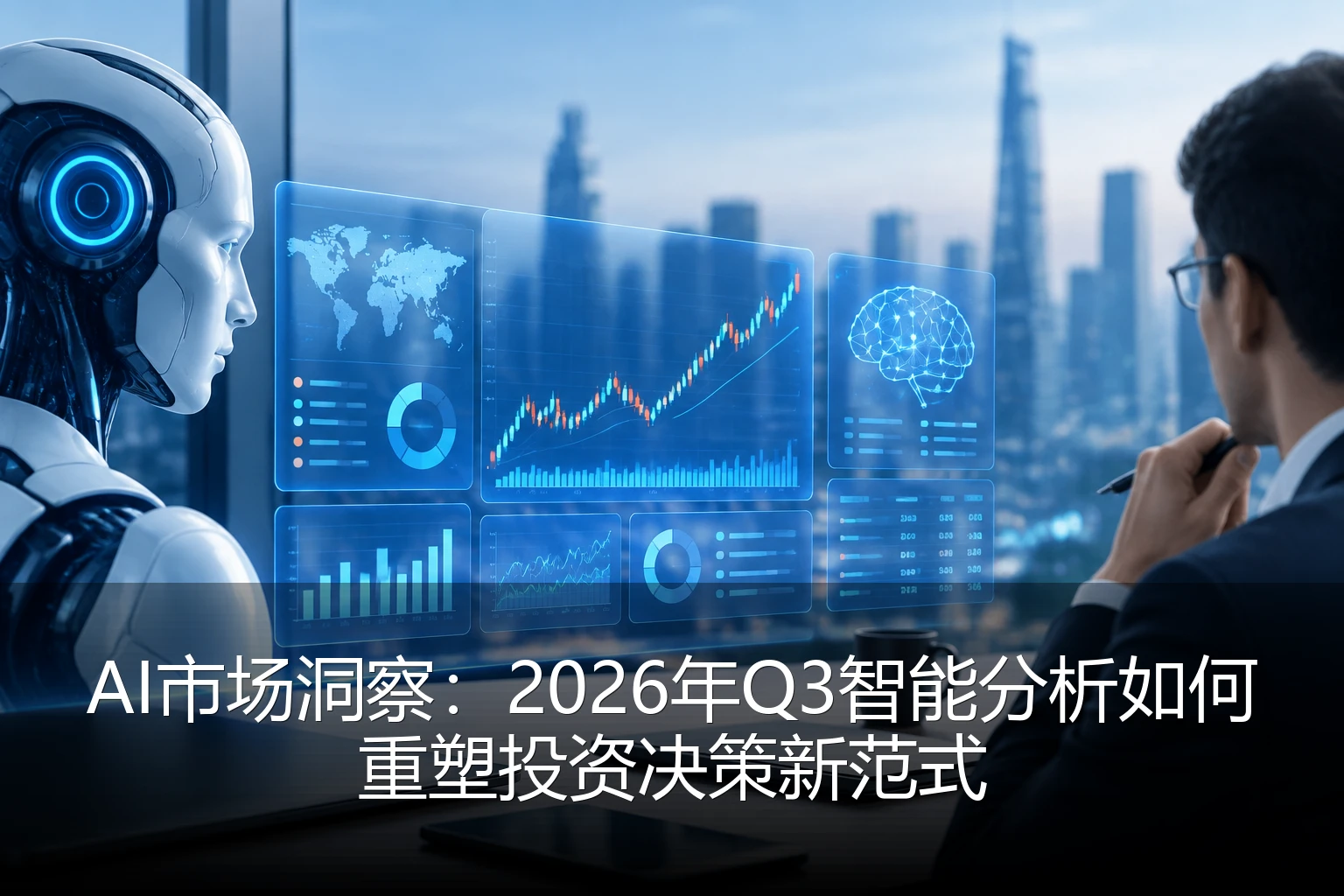
AI Market Insight: How Q3 2026 Intelligent Analysis Reshapes the New Paradigm of Investment Decision-Making
In the third quarter of 2026, artificial intelligence technology is reshaping global financial markets at an unprecedented pace. With continuous breakthroughs in big data, deep learning, and natural language processing technologies, AI has gradually evolved from an auxiliary tool to the core driving force of investment decision-making. This article will delve into the latest advancements in AI market insight technology, analyze its revolutionary impact on investment decision-making processes, and look forward to future development trends.
Latest Advancements in AI Market Insight Technology
In 2026, AI market insight technology has entered a mature stage, demonstrating unprecedented analytical capabilities and prediction accuracy. According to the latest industry reports, AI systems adopted by leading investment institutions can already process more than 10TB of real-time market data, covering market information from over 100 global exchanges, news and information, social media sentiment, and macroeconomic indicators.
These systems adopt advanced deep learning architectures, especially the combination of Transformer and Graph Neural Networks (GNN), enabling them to capture nonlinear relationships and complex interactions in the market. Compared with traditional quantitative models, the new generation of AI market insight systems show significant advantages in processing unstructured data, able to extract key information from news texts, research report summaries, and meeting records, and convert them into quantifiable market signals.
Multimodal analysis has become another important trend in AI market insight. Systems can simultaneously process structured market data and unstructured text, images, voice and other forms of information, building a more comprehensive market cognition. For example, an AI system developed by a well-known hedge fund can analyze the micro-expressions and tone changes of company executives at press conferences, using them as auxiliary indicators to assess the company's future performance.
How AI Changes Investment Decision-Making Processes
AI market insight technology is fundamentally changing traditional investment decision-making processes, with profound changes in all aspects from information collection and analysis to final decisions.
In the information collection stage, AI systems can monitor global market dynamics in real-time, automatically filter out key information relevant to investment portfolios, significantly reducing analysts' information screening time. According to industry statistics, investment institutions using AI systems have improved information processing efficiency by about 300%, allowing analysts to devote more energy to in-depth research and strategic thinking.
In the analysis phase, AI systems can identify market patterns and correlations that are difficult to discover with traditional methods. For example, an AI system discovered a lag correlation between supply chain changes in a specific industry and stock performance in another industry, which provided new opportunities for cross-industry investment. AI can also conduct scenario analysis and stress testing, simulating the performance of investment portfolios under different market conditions, helping investors better manage risks.
At the decision-making level, AI systems not only provide data support but also generate investment recommendations and strategy explanations. Advanced AI systems can explain their recommendation logic in natural language, enabling investors to understand the AI's decision-making process and enhance trust. This "explainable AI" technology solves the trust problems faced by early black-box models, promoting the widespread application of AI in investment decision-making.
Case Studies
In Q3 2026, several leading investment institutions demonstrated the practical application results of AI market insight technology. For example, a global top asset management company used an AI system to successfully predict the structural adjustment of the technology sector, adjusting its investment portfolio two weeks in advance and avoiding potential losses of about 8%.
Another hedge fund focused on emerging markets developed a multilingual AI analysis system that can process news and social media information in more than 20 languages in real-time, successfully capturing the market reaction to policy changes in a Southeast Asian country, timely adjusting investment strategies, and obtaining excess returns.
In the Hong Kong market, a local securities firm used an AI sentiment analysis system to comprehensively analyze analyst research reports, news comments, and social media sentiment, successfully predicting the short-term volatility of a large technology stock, providing clients with precise trading timing recommendations.
Industry Expert Views
Many industry experts have expressed optimistic views on the future development of AI market insight technology. The CIO of a well-known quantitative fund in Hong Kong stated: "AI has evolved from an auxiliary tool to the core driving force of investment decision-making. In the next five years, we will see more automation and intelligence in investment processes, but this does not mean that human analysts will be replaced, but rather the need to develop new capabilities for collaborating with AI."
A head of an international research department pointed out: "The greatest value of AI market insight technology lies in its ability to process massive information and identify complex patterns, which is difficult for human analysts to match. However, investment decision-making also needs to be combined with human understanding of the macro market environment and business logic. Human-AI collaboration will be the mainstream model in the future."
A professor specializing in the intersection of AI and finance believes: "With the continuous development of AI technology, we are witnessing a fundamental transformation in the paradigm of investment decision-making. From relying on experience and intuition to data-driven scientific decision-making, this transformation will bring higher market efficiency and more rational investment behavior."
Future Trends Outlook
Looking at the second half of 2026 and the coming years, AI market insight technology will show the following development trends:
- Multi-agent collaboration will become a new paradigm in AI market analysis. AI agents with different specialties will work together, some focusing on macroeconomic analysis, some in-depth industry research, and others focusing on technical analysis, building comprehensive market cognition through collaborative work.
- The combination of edge computing and AI will make market analysis more real-time. With the popularization of 5G and 6G networks, AI systems will be able to conduct preliminary analysis at edge nodes where data is generated, reducing data transmission latency and achieving faster market response.
- Explainable AI technology will further develop, improving the transparency and credibility of AI decisions. This will help solve the AI black box problem, enabling investors to better understand the AI's decision-making logic and enhance trust in AI systems.
- Personalized AI advisors will become popular, providing customized market insights and investment recommendations for investors with different risk preferences and investment goals. This will significantly lower the threshold for professional investment services, enabling more ordinary investors to obtain high-quality investment guidance.
- The integration of AI and blockchain technology will bring new market transparency and trust mechanisms. Through smart contracts and decentralized data storage, AI systems will be able to access more reliable and transparent market data, improving analysis accuracy.
Conclusion
In Q3 2026, AI market insight technology is developing at an unprecedented pace, reshaping all aspects of investment decision-making. From information collection and analysis to final decisions, AI systems demonstrate powerful analytical capabilities and prediction accuracy, providing investors with unprecedented market insight.
However, AI is not a panacea. It needs to be combined with human professional knowledge and experience to maximize its value. In the future, human-AI collaboration will become the mainstream model of investment decision-making, with AI responsible for data processing and pattern recognition, and humans responsible for strategic thinking and final decisions.
With continuous technological advancement, AI market insight will become more accurate, real-time, and personalized, providing investors with more powerful decision support. In this process of change, investors need to continuously learn and adapt, develop new capabilities for collaborating with AI, to maintain a competitive advantage in the increasingly complex market environment.