

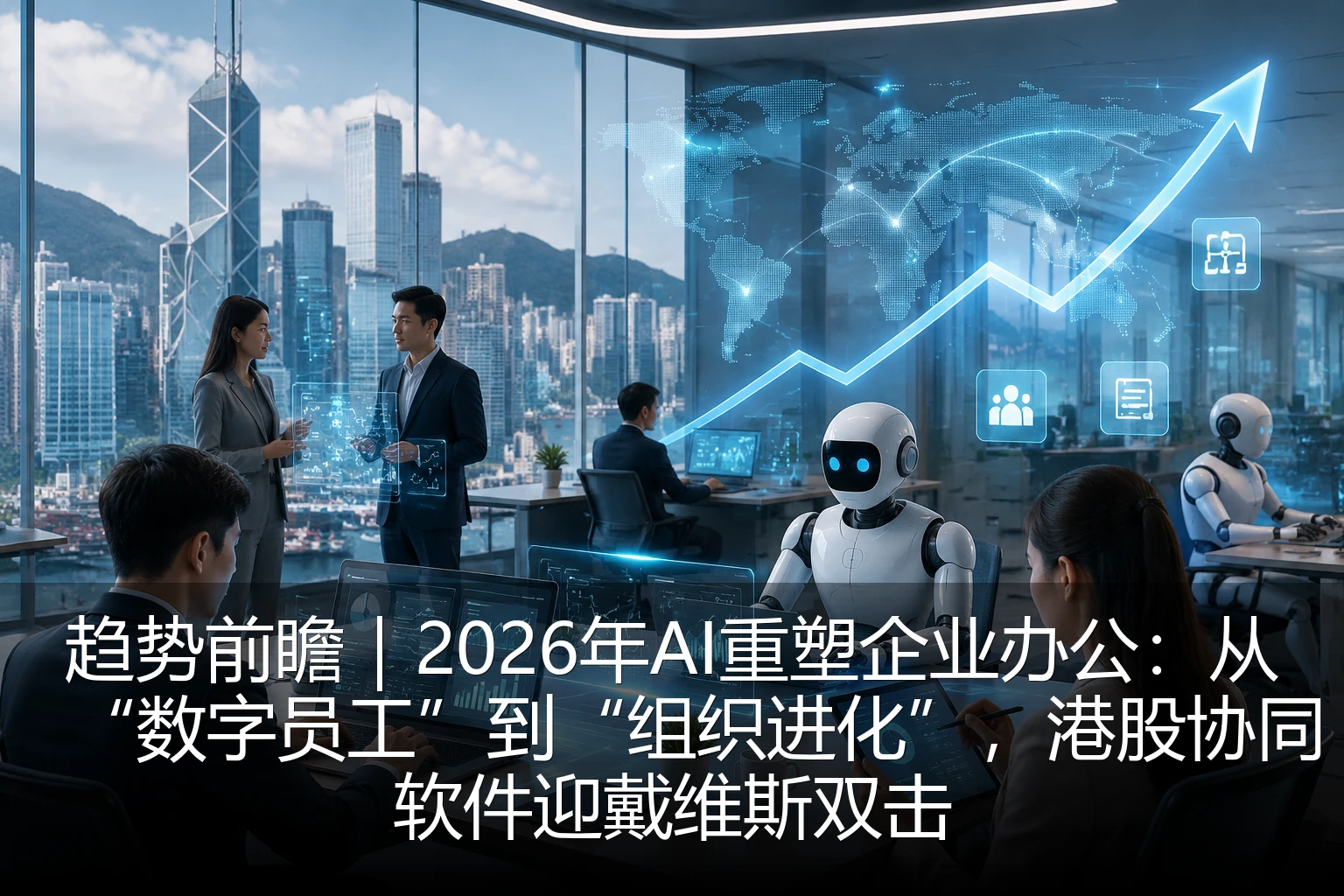
As we move into August 2026 and look back at the past two years of AI development from the Q3 perspective, it's evident that a significant paradigm shift is occurring: the focus of AI technology is evolving from "impressive generative capabilities" to "deep action capabilities." After the large model battle royale of 2024 and the trial-and-error phase of application scenarios in 2025, 2026 is widely recognized in the industry as the "Year of AI Agents." Among numerous implementation scenarios, the enterprise office market is undergoing a silent revolution from "auxiliary tools" to "digital employees." For the Hong Kong-listed SaaS and collaborative software sector that has been under long-term valuation pressure, this represents not just a functional upgrade but a historic opportunity to reshape business models and valuation logic.
I. Paradigm Shift: From "Copilot" to "Agent"
In 2024, most AI introduced to enterprises existed in the form of "copilots." Whether writing email summaries or generating meeting minutes, the AI's role was passive—waiting for human instructions, providing suggestions, and ultimately leaving the decision to humans. However, entering 2026, with the enhanced reasoning capabilities of multimodal large models and the maturation of Agent architectures, AI is transforming into "digital employees" with autonomous planning, tool invocation, and execution capabilities.
The core of this transformation lies in "autonomy." Today's AI office assistants are no longer limited to Q&A within dialog boxes but can complete complex task chains across applications and platforms. For example, in the common investment bank research report writing scenario in the Hong Kong market, the new generation of AI systems can autonomously extract data from Bloomberg terminals, call internal report libraries for comparative analysis, generate drafts, and even automatically format and submit for review. This leap from "point assistance" to "chain execution" greatly releases human capital, freeing enterprise employees from tedious repetitive work and redirecting them toward more creative strategic decision-making.
For technology stocks in the Hong Kong market, this trend means that relying solely on "connecting to large model APIs" is no longer compelling to investors. The market is beginning to reevaluate vertical software vendors that have private data accumulation and can build complex workflow closed loops. Those who can first truly integrate AI Agents into their business processes will gain the high ground in the next round of industry reshuffling.
II. Organizational Evolution: Management Restructuring Under the New Human-AI Collaboration Paradigm
The proliferation of AI digital employees is profoundly changing corporate organizational structures and management models. 2026 trend forecasts show that traditional hierarchical structures are facing challenges, with more flat and flexible "network organizations" emerging. This is not simply about layoffs and efficiency gains but a deep reflection on "human-AI division of labor."
1. The "Algorithmization" of Middle Management
In the past, a significant portion of middle managers' energy was consumed on information transmission, progress tracking, and performance statistics. With AI's comprehensive involvement in office scenarios, these highly standardized management tasks are being taken over by AI. AI systems can monitor project progress in real-time, automatically identify bottlenecks, and allocate resources based on preset rules. This means that the demand for middle managers in enterprises will shift from "managers" to "leaders," with greater emphasis on their ability to dispatch AI employees and make decisions on complex non-standard issues.
2. Evolution from "Prompt Engineering" to "AI Orchestration"
As AI capabilities strengthen, the way ordinary employees interact with AI is also upgrading. Simple "prompt engineering" is no longer sufficient to handle complex business needs, replaced by "AI orchestration" capabilities. Employees need to coordinate multiple AI Agents (such as data analysis Agent, copywriting Agent, compliance review Agent) to work together, much like conducting an orchestra. The popularization of this skill will exponentially increase individual combat effectiveness, thereby driving a leap in overall human efficiency for enterprises.
For investors focusing on Hong Kong stock fundamentals, the direct benefit brought by this organizational evolution is the reduction of corporate management costs and improvement of operational efficiency. In financial statements, this will be reflected in the optimization of SG&A (Sales, General & Administrative expenses) ratio and significant improvement in profit margins.
III. Hong Kong Collaborative Software Sector: An Opportunity for a Double Catalyst
Over the past two years, affected by the Federal Reserve's interest rate hike cycle and global liquidity tightening, the Hong Kong SaaS sector has experienced a prolonged valuation correction. The market's tolerance for high-growth but unprofitable tech stocks has decreased, shifting toward immediate profitability. However, as the AI office revolution deepens in 2026, this sector is facing dual drivers of "performance growth" and "valuation recovery," a typical "double catalyst."
1. Reshaping of Valuation Logic: Switch from PS to PE
In the early stages of SaaS development, the market was accustomed to using price-to-sales (PS) ratio to measure enterprise value because revenue growth was more important than profits. However, with the empowerment of AI technology, the marginal cost of SaaS software has significantly decreased, and customer acquisition value (ARPU) has been enhanced through AI value-added services. This enables collaborative software companies to achieve break-even or even high profit margins more quickly. At that point, the market's valuation anchor will shift from PS to price-to-earnings (PE) ratio. For leading Hong Kong-listed SaaS enterprises that can use AI technology to increase net margins to over 20%, their valuation center有望实现质的飞跃.
2. Data Barriers Become Moats
As general large models become increasingly homogeneous, data has become the key to distinguishing winners. Many collaborative software vendors listed in Hong Kong, after years of deep cultivation, have accumulated massive amounts of enterprise private data and behavioral data. This data is a valuable asset for training vertical domain AI Agents. Compared to general ChatGPT-like products, AI office assistants fine-tuned on enterprise private data can provide more precise and enterprise-contextual services. This data barrier forms a strong moat, enabling leading enterprises to further enhance customer stickiness and reduce churn rates through AI value-added services.
3. Dual Benefits of Domestic Replacement and International Expansion
For Chinese technology stocks in the Hong Kong market, in addition to technology dividends, they also face dual opportunities of domestic replacement and international expansion. On one hand, with the improvement of domestic data security regulations, government and enterprise customers are more inclined to choose secure and controllable local office software; on the other hand, with AI breaking down language and cultural barriers, Hong Kong-listed software companies can more smoothly expand into Southeast Asian and "Belt and Road" markets, opening new growth ceilings.
IV. Investment Risks and Industry Challenges
Despite the broad prospects, we must remain clear-headed amidst optimism. On the path of AI reshaping corporate offices, there are still non-negligible risks and challenges.
1. Data Privacy and Compliance Risks
AI Agents need access to a company's core data to function, which undoubtedly increases the risk of data leakage. Especially for sensitive industries like finance and healthcare, how to ensure data compliance while leveraging AI to improve efficiency is a challenge that enterprises must solve. Hong Kong-listed companies need to invest significant resources in upgrading security architectures in this regard, which may increase R&D costs in the short term.
2. Hallucination Issues and Responsibility Attribution
Although large model technology has advanced significantly, the "hallucination" problem has not been completely eliminated. When AI digital employees make wrong business decisions autonomously, how should responsibility be attributed? To the enterprise, software provider, or model provider? There is no legal consensus on this yet. This uncertainty may to some extent delay the pace of enterprises' full deployment of AI Agents.
3. Ethical and Employment Impact
As AI's ability to replace white-collar work becomes stronger, employment ethics issues at the social level will gradually emerge. Although technological progress will create new jobs in the long run, short-term structural pain is inevitable. Enterprises need to properly handle human-AI relationships to avoid internal turmoil or public relations crises caused by overly aggressive AI replacement.
V. Conclusion: Embracing the "AI Native" Future
In Q3 of 2026, we are standing at the critical point of the explosion of enterprise office intelligence. From "tools" to "employees," from "assistance" to "autonomy," AI is redefining productivity. For the Hong Kong market, this is not just a technological iteration but an opportunity for asset value re-evaluation.
When looking for investment targets, investors should focus on enterprises with "AI Native" genes—those that are designed for AI from the underlying architecture, have strong data closed loops, and can clearly demonstrate the actual results of cost reduction and efficiency improvement brought by AI implementation. Those vendors that remain stuck in old software thinking and try to "ride the wave" through simple interfaces will eventually be abandoned by the market.
In this era of transformation, the power of trends far exceeds our imagination. The wave of AI reshaping corporate offices has arrived. For astute investors, now is the critical moment to position for the future and capture the value revaluation dividends of Hong Kong technology stocks. Let us wait and see how these "digital employees" will trigger the next decade of business miracles.