

Hong Kong IPO rebound is clear: tech firms cluster, long-term capital flows in, and A+H expands faster
Keywords: Hong Kong IPO, tech firms, cornerstone investment, A+H, southbound capital, Hong Kong stock market, policy tailwinds
Since the start of the year, driven by both improved liquidity and policy tailwinds, the Hong Kong stock market has shown a clear rebound, with the primary market especially active. As IPO volumes and fundraising size rise in tandem, Hong Kong is gradually moving from “valuation repair” to “confidence rebuilding,” while the market ecosystem is also quietly changing. Tech firms are accelerating listings in Hong Kong, long-term capital continues to add exposure, and the popularity of A+H structures remains strong, together sketching a new growth picture for the Hong Kong market.
1. IPO rebound: both volume and scale rise
According to Wind data, as of June 24, 72 companies in Hong Kong had completed initial public offerings (IPOs) this year, a significant increase from 43 in the same period last year. Total funds raised reached HK$153.62 billion, up 41.1% year on year. Both the pace of issuance and the scale of financing show the recovery and strengthening of Hong Kong's financing function.
This rebound is not driven by a single factor, but by the combined effect of policy, capital, and valuation. On one hand, HKEX has continued to refine the Chapter 18C regime for specialist technology companies, further lowering the listing threshold for hard-tech firms and improving review and issuance efficiency, enabling more companies at key stages of technological iteration to access capital through Hong Kong. On the other hand, the external liquidity environment has improved, with expectations of Fed rate cuts and the cycle continuing, while southbound capital keeps flowing in, providing Hong Kong with a more ample funding base. At the same time, the valuation attractiveness of Hong Kong's tech sector, after prior adjustments, has gradually become apparent, and international investors' willingness to allocate to high-quality assets has risen noticeably.
2. Tech firms take the lead as capital markets move toward innovation
By industry structure, one of the most striking features of Hong Kong's IPO market this year is the concentration of tech listings. Data show that among the 72 IPO companies, the information technology sector accounted for 23 listings, with total funds raised of HK$91.67 billion, nearly 60% of overall proceeds. Among them, semiconductor products and equipment raised HK$36.02 billion, ranking first among subsectors.
This trend sends two important signals: first, global capital is paying more attention to China's technology manufacturing and hard-tech sectors; second, Hong Kong's institutional fit for serving tech companies is steadily improving. For industries such as semiconductors, advanced electronics, and communications equipment that require heavy R&D investment, Hong Kong not only provides financing support, but also opens an international capital channel, helping companies connect with global industrial chain resources.
At a deeper level, the clustering of tech firms in Hong Kong helps improve listed company structure, strengthen index representation, and enhance the market's long-term allocation value. Especially amid intensifying global tech competition and accelerating industrial chain restructuring, Hong Kong is poised to become an important hub for Chinese tech firms connecting with international capital and global markets.
3. Long-term capital participates actively as cornerstone investment heats up
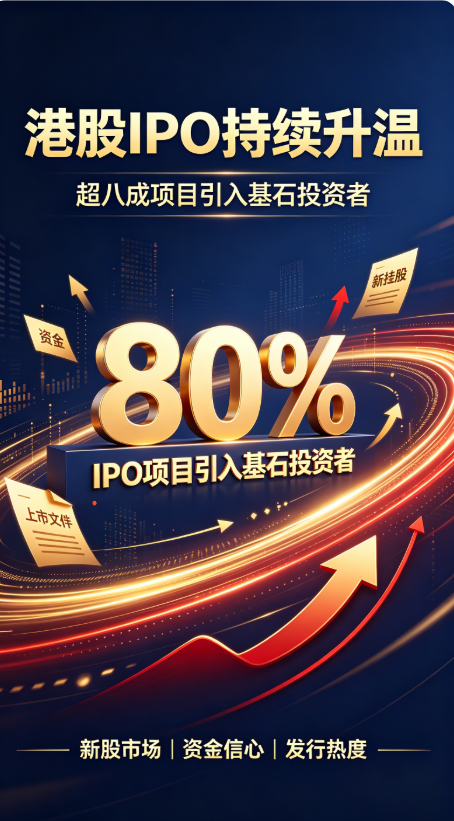
Another notable feature of the Hong Kong IPO rebound is the more active entry of long-term capital and the clear rise in cornerstone investment interest. Data show that this year, 84.7% of IPOs introduced cornerstone investors, and cornerstone subscription funds accounted for 40.5% of total funds raised. Participants include foreign asset managers, Chinese insurers, industry leaders, sovereign funds, and other long-term institutions, reflecting market recognition of the quality and growth prospects of Hong Kong new listings.
The continued activity of cornerstone investors not only helps stabilize issuance pricing, but also boosts market confidence to some extent. More importantly, it means more and more long-term capital is willing to make medium- to long-term allocations in Hong Kong's hard-tech sectors rather than focusing solely on short-term trading gains. For companies, the introduction of cornerstone investors is not only an important safeguard for a successful fundraising, but also helps raise market visibility and subsequent liquidity.
From a market logic perspective, changes in long-term capital preferences often signal a shift in judgments about industry prospects and asset quality. The current rise in cornerstone investment interest shows that both international and domestic institutions are broadly optimistic about the long-term growth potential of China's technology manufacturers, and it also shows that Hong Kong's appeal in global asset allocation is gradually recovering.
4. A+H structures are gaining momentum, and companies' offshore financing needs are strengthening
It is worth noting that among the 72 Hong Kong IPO companies this year, 21 are already listed in A-shares, accounting for 29.2%. Of these, 10 are information technology companies, covering multiple high-growth sectors such as semiconductors, advanced electronics, and communications equipment, with total fundraising of HK$59.8 billion.
The increase in A+H companies reflects multiple real-world needs. First, as a mature international capital market, Hong Kong can help companies broaden overseas financing channels and enhance global brand influence, especially suiting the large funding needs of industries such as semiconductors and advanced manufacturing for overseas factories, global R&D, and supply-chain expansion. Second, the filing regime for overseas listings by A-share companies has continued to improve, reducing the time cost and compliance threshold for cross-border listings. Third, against the backdrop of accelerating global industrial chain restructuring, science and innovation companies need to further connect with international industrial capital and global investors through Hong Kong.
Take Huaqin Technology as an example: one of its key reasons for listing in Hong Kong is to build dual capital platforms at home and abroad and broaden financing channels to match the needs of overseas capacity expansion and industrial chain investment. At the same time, a Hong Kong listing also helps raise brand visibility in international markets and strengthen recognition among overseas customers and supply-chain partners. In other words, the A+H model is gradually evolving from a simple financing tool into an important fulcrum for a company's global operations.
5. Looking to the second half, Hong Kong IPOs are likely to continue their recovery trend
From the current situation, the rebound in Hong Kong's IPO market remains on solid footing. First, there is a substantial pipeline of pending projects: HKEX currently still has 158 A-share companies in the application queue, covering semiconductors, advanced equipment manufacturing, consumer sectors, and more, providing a solid supply for future offerings. Second, the expectation that Chinese concept stocks will return to Hong Kong still exists, and some high-quality companies continue to view Hong Kong as an important capital platform. Third, policy benefits such as reductions in listing fees and adjustments to stamp duty continue to be implemented, which will further enhance Hong Kong's attractiveness.
More importantly, a new positive feedback loop is taking shape in Hong Kong: the clustering of high-quality tech firms attracts long-term capital; increased allocation by long-term funds, in turn, boosts market valuations and liquidity; and as valuations improve, more companies are willing to list in Hong Kong to raise funds, creating a “technology-capital-industry” cycle. If this mechanism continues to strengthen, Hong Kong is likely to extend its recovery in the second half of the year and further consolidate its position as an international financing platform for China's high-quality companies.
Conclusion
Overall, the recovery in this year's Hong Kong IPO market is not just a rebound in fundraising size, but the result of the coordinated improvement of market confidence, the institutional environment, and industrial structure. With tech firms taking center stage, long-term capital participating actively, and A+H structures continuing to expand, Hong Kong is moving from a “trading market” to a platform for value discovery and industrial empowerment. Looking ahead, as policy tailwinds continue to be released, international capital gradually returns, and high-quality companies keep clustering, the Hong Kong market is expected to show stronger resilience and a larger imagination space in the new cycle.