

Introduction: The "Last Mile" of AI Implementation — The Intelligent Awakening of the Real Economy
In August 2026, looking back at the tech wave of the past two years, we discover a significant turning point: the focus of AI competition has shifted entirely from the parameter race of cloud large models to the penetration and reconstruction of the real economy. In this grand industrial narrative, industrial logistics is becoming the "bridgehead" where AI technology lands most rapidly and achieves the clearest commercial realization.
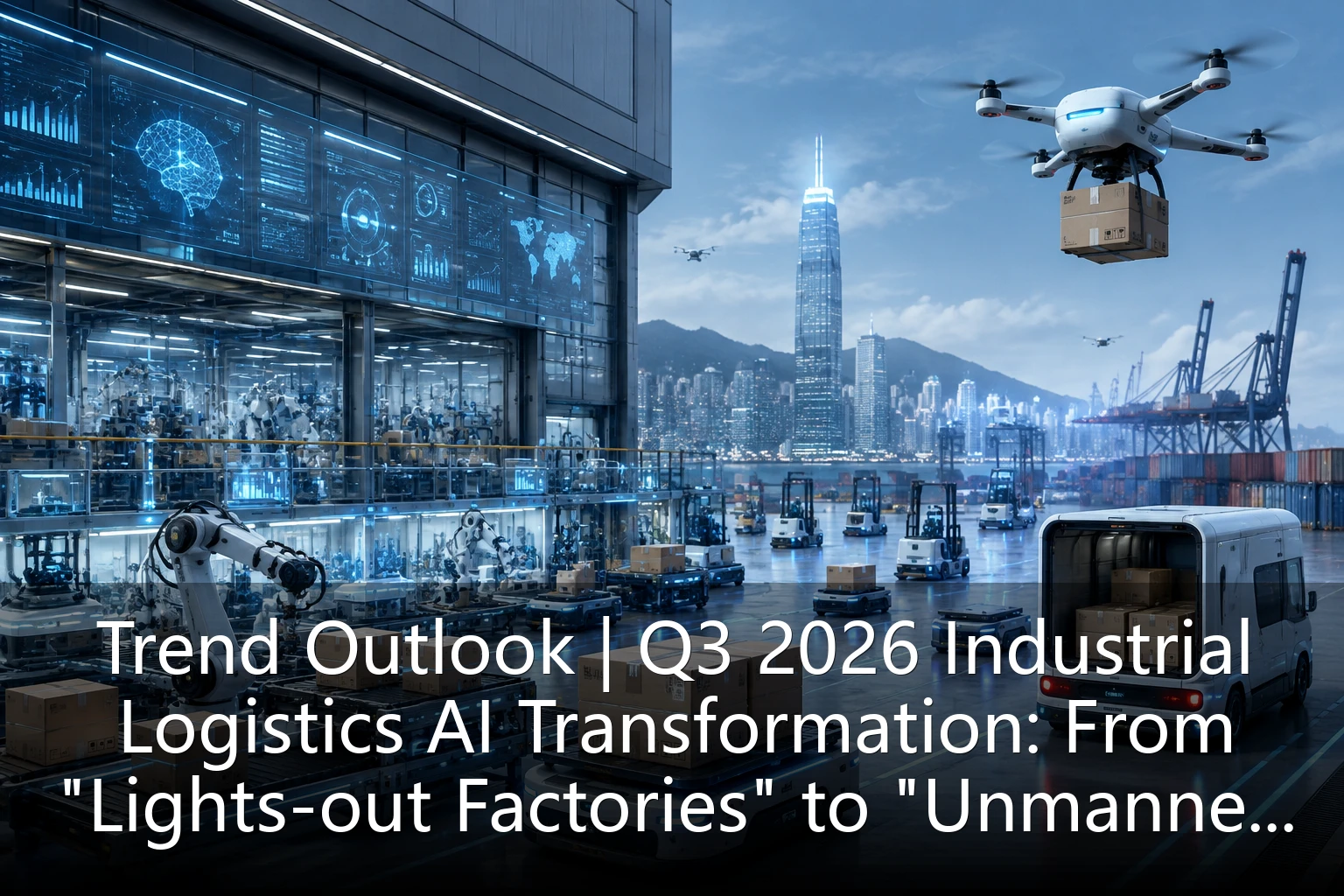
From the full automation of "lights-out factories" to the unmanned nature of last-mile delivery, industrial logistics is undergoing a profound transformation from "physical labor substitution" to "mental empowerment." For investors, this trend not only implies an exponential increase in production efficiency but also heralds a round of valuation reassessment based on "new quality productive forces" for the smart manufacturing supply chains in Hong Kong and A-share markets. This article will deeply analyze the latest trends in the AI transformation of industrial logistics in Q3 2026, interpreting the technological drivers and market opportunities behind them.
Technological Singularity: A Paradigm Shift from "Automation" to "Autonomy"
For a long time, the mainstream in industrial logistics has been automated equipment, such as AGVs (Automated Guided Vehicles) and robotic arms. However, traditional automation relies on preset rules and fixed environments, often appearing clumsy and fragile when facing complex and changing real-world scenarios. Today in 2026, with the maturity of embodied intelligence and multimodal large models, this situation is being completely rewritten.
The breakthrough in core technology lies in the large-scale commercial use of VLA (Vision-Language-Action) models. Unlike traditional vision algorithms, VLA models endow robots with the ability to "understand" and "decide." In the latest financial reports of several leading robotics companies listed in Hong Kong, we can clearly see this technological generation gap: the new generation of intelligent sorting robots no longer need to pre-enter image data for tens of thousands of SKUs. Instead, they can identify unseen packages through vision like humans, and plan the optimal grasping and placement paths in real-time based on the package's material, shape, and label information.
This leap from "instruction execution" to "task understanding" marks the official entry of industrial logistics into the era of "Cognitive Logistics". In Q3 2026, we observed that more and more intelligent warehousing projects began to adopt scheduling systems based on large models. These systems no longer merely optimize path algorithms but can globally understand the warehouse's operational status, predict order peaks, and dynamically adjust the collaborative work of dozens of different types of robots. The emergence of this "swarm intelligence" has increased the overall efficiency of logistics systems by over 40% compared to 2024, achieving a qualitative leap in flexibility.
Market Drivers: Why is 2026 the Explosive Period for Industrial Logistics?
Why did the intelligence of industrial logistics usher in explosive growth in the second half of 2026? This is not accidental, but the result of the resonance of three forces: technological maturity, changes in labor structure, and the demand for supply chain reconstruction.
- Irreversible Changes in Labor Structure: With population aging and the shift in employment concepts of the younger generation, the manufacturing and logistics industries have long faced a "labor shortage." In 2026, this contradiction is particularly prominent. Not only simple porters but also experienced dispatchers and forklift drivers have seen huge gaps. Enterprises have had to turn "replacing humans with machines" from an option into a necessity. AI-empowered robots precisely fill this huge vacuum of productivity.
- Decline in Computing Costs and Proliferation of Edge Computing: A major bottleneck limiting the promotion of industrial AI in the past was computing power cost. However, with the mass production and price decline of edge AI chips from 2025 to 2026, the cost of high-performance inference has dropped by about 60%. This makes it possible to deploy large model inference capabilities on every forklift and every sorting head. Semiconductor design companies in Hong Kong stocks have benefited from this round of edge computing power demand, and their performance showed significant exceeding-expectation growth in Q3.
- Urgent Need for Global Supply Chain Resilience: Having experienced the global supply chain shocks of the past few years, enterprises have put forward extremely high requirements for supply chain "resilience" and "transparency." AI-driven logistics systems can not only improve efficiency but also simulate and predict supply chain risks in real-time through digital twin technology. This ability to "prevent trouble before it happens" has extremely high strategic value for multinational manufacturing enterprises.
Deep Dive into the Industrial Chain: Who is Reshaping the Valuation Logic of HK and A-Share Markets?
In this wave of AI transformation in industrial logistics, investment opportunities are not evenly distributed but show obvious stratification characteristics of the industrial chain. We need to penetrate the surface to find targets with real core competitiveness.
1. Core Hardware Layer: Dual Upgrade of Perception and Execution
Although hardware is regarded as "traditional manufacturing," in the AI era, the value logic of hardware has fundamentally changed. Traditional robotic arm manufacturing enterprises are transforming into "intelligent terminal manufacturers." In the A-share market, enterprises capable of producing high-precision torque sensors and visual modules have seen a significant increase in product premium capability. Because the accuracy requirements for environmental perception of multimodal robots far exceed traditional automation, the penetration rate of high-end sensors broke through 30% in Q3 2026.
At the same time, precision manufacturing leaders in the Hong Kong stock market, relying on their technological accumulation in servo systems and reducers, have successfully cut into the global high-end robot supply chain. The valuation logic of these enterprises is switching from "cyclical stocks" to "growth stocks," and the market is willing to give them a higher P/E ratio to reflect their scarcity in the AI hardware wave.
2. Algorithm and System Integration Layer: The "Soul" Defining Intelligence
This is the link with the highest added value and the deepest moat in the industrial chain. The core of AI industrial logistics does not lie in how strong the robot is, but in how "smart" it is. System integrators with scenario data accumulation and algorithm iteration capabilities are becoming the darlings of the market.
For example, in the e-commerce logistics field, leading AI logistics service providers have built unique logistics large models through data training from hundreds of millions of package sorting. This enables the systems they deploy to maintain zero-fault operation under extreme traffic scenarios like "Double 11." This scale effect based on the data flywheel constitutes an extremely strong competitive barrier. Investors should focus on Hong Kong SaaS enterprises and software service providers that have deep data accumulation in vertical fields (such as pharmaceutical cold chain, auto parts logistics).
3. New Business Format Application Layer: The Commercial Closed Loop of Unmanned Delivery
In Q3 2026, another highlight worth watching is the large-scale commercial use of unmanned delivery. Unlike the "road testing" and "pilots" of previous years, in the first half of this year, several leading logistics companies achieved normalized operations of unmanned delivery vehicles in specific areas such as Hong Kong and Shenzhen.
Behind this is the maturity of L4 autonomous driving technology in closed and semi-closed scenarios. Autonomous driving solution providers in Hong Kong stocks, through deep binding with logistics giants, have finally ushered in a period of performance release. More importantly, unmanned delivery not only reduces delivery costs but also reconstructs the business model of "instant retail," making "30-minute delivery" possible over longer distances and at lower costs, thereby driving the activity of the entire local life service industry chain.
Investment Strategy: Seeking Alpha Returns from "AI + Manufacturing"
Facing the magnificent trend of AI transformation in industrial logistics, how should investors layout? We believe that pure concept speculation has receded, and the market will enter a performance verification period. The following strategies are worth attention:
First, pay attention to leading enterprises with strong "going global" capabilities. China possesses the world's most complete industrial robot industry chain and is at the forefront of AI application. Hong Kong stock enterprises that can export mature "Chinese solutions" to Southeast Asia, Europe, and even the US market will have broader incremental space, and their valuation ceiling will be opened.
Second, distinguish between "True AI" and "Pseudo AI". Some traditional automation companies simply claim to transform to AI by adding simple sensors or cloud platforms; such companies often find it difficult to enjoy high valuation premiums. Real opportunities lie in enterprises that deeply embed AI into core business processes, achieving quantifiable and verifiable cost reduction and efficiency improvement. Investors should focus on the proportion of algorithm and software personnel in corporate R&D investment, as well as the trend of gross profit margins of their products.
Finally, value data assets. In the AI era, data is the new oil. Enterprises that have accumulated massive amounts of high-quality industrial data during operations and possess data cleaning, labeling, and training capabilities will occupy the commanding heights in future competition. Such enterprises often have strong platform attributes; once the business model runs through, their growth curve will show non-linear characteristics.
Conclusion: Embracing the New Era of "Embodied Intelligence"
The AI transformation of industrial logistics in Q3 2026 is not only an iteration of technology but also a reshaping of human production methods. From the tireless robotic arms in "lights-out factories" to the unmanned delivery vehicles shuttling through city streets, artificial intelligence is injecting strong growth momentum into the real economy in a concrete form.
For the capital market, this is both a challenge and a huge opportunity. As microcosms of China's technological innovation, Hong Kong and A-share markets nurture a batch of smart manufacturing enterprises with global competitiveness. With the full opening of the "Cognitive Logistics" era, those enterprises that can keenly capture trends, deeply cultivate core technologies, and build data barriers will surely stand out in the future value reassessment, bringing rich long-term returns to investors. We are standing at the starting point of the new era of "Embodied Intelligence," let us wait and see.