

Sanhuan Group’s Hong Kong Listing: More Than 50 Years in Electronic Ceramics, Targeting New Growth in High-End Manufacturing
Keywords: Sanhuan Group, Hong Kong listing, electronic ceramics, prospectus, semiconductor, AI data centers, domestic substitution, capacity expansion
Introduction
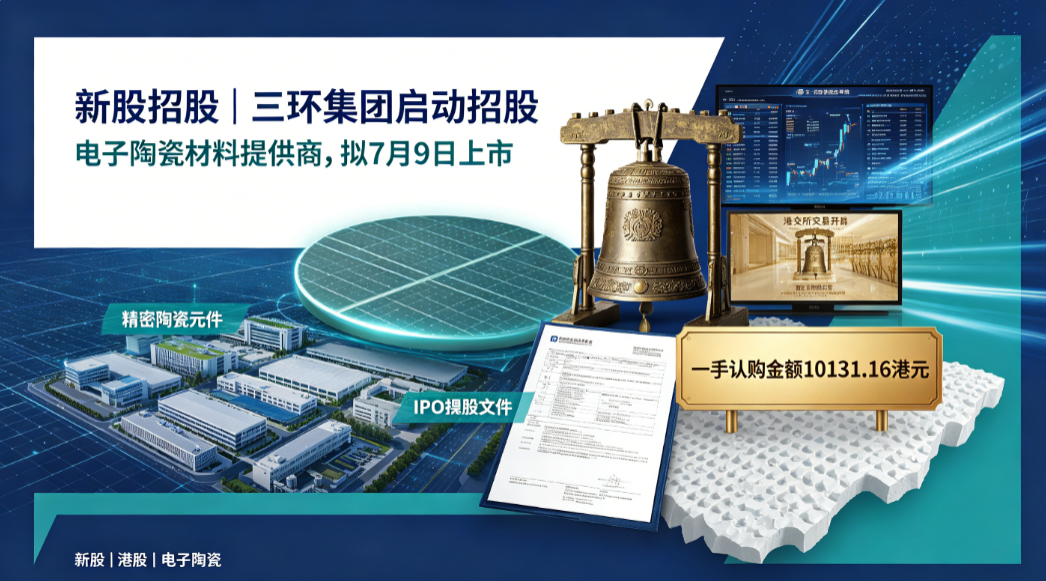
Against the backdrop of the rapid upgrading of the global electronics and information industry, the importance of key foundational materials and core components continues to rise. With advantages such as heat resistance, corrosion resistance, strong insulation, and high stability, electronic ceramics are increasingly used in high-growth sectors including communications, AI and data centers, automotive electronics, semiconductor manufacturing and packaging. Recently, Sanhuan Group (06951.HK), which has focused on this field for more than 55 years, launched its Hong Kong IPO, with public offering scheduled from June 30 to July 6 and listing planned for July 9. This move into the capital markets not only marks a new stage in the company’s global expansion, but also provides important funding support for further capacity expansion, R&D, and technological iteration.
More Than 50 Years of Accumulation, Building a Complete Product Portfolio
Sanhuan Group has long focused on electronic ceramic materials and components, and has built a relatively complete business system around materials, parts, devices, and modules. Today, its product portfolio covers four major categories: electronic and ceramic materials, electronic components, communication devices, and equipment components, with applications extending to communications, AI and data centers, consumer electronics, automotive electronics, semiconductor manufacturing and packaging, new energy, and intelligent industrial control.
From a supply-chain perspective, Sanhuan Group is not just a component supplier; starting from foundational materials, it extends step by step into key components, high-end devices, and modules, with strong synergies and product-platform capabilities. This layout helps improve customer stickiness on the one hand, and on the other strengthens the company’s resilience to cycles across different industries.
R&D-Driven, Strengthening the Technology Moat
In the electronic ceramics industry, the real competitive barrier is often not a single product, but the system integration of material formulations, forming processes, sintering technology, and scaled manufacturing capabilities. Sanhuan Group’s R&D organization consists of a research institute and technical teams from its business units, covering key stages such as raw-material formulation, forming, and sintering processes. The company also holds multiple patents and has helped draft and revise a number of industrial standards.
This integrated “R&D—pilot production—mass production” mechanism means the company can not only continue to launch new materials and processes, but also rapidly turn innovation into product platforms suitable for mass production. For Chinese manufacturing, which is currently at the intersection of domestic substitution and high-end upgrading, companies that can balance performance, stability, and large-scale delivery are more likely to win orders and market share as global supply chains are reshaped.
Capacity Expansion and Global Footprint Advance Together, Improving Supply Resilience
As demand in downstream communications, AI servers, automotive electronics, and semiconductors continues to grow, capacity assurance and delivery efficiency have become key factors in manufacturing competition. Sanhuan Group currently has multiple local production bases and strategic overseas locations, giving it the ability to coordinate capacity across sites, while expanding through a sales network that covers major global markets.
The value of this layout is not only reflected in scale expansion, but also in supply-chain resilience. Faced with shifts in the international trade environment, stronger customer requirements for local sourcing, and shorter global delivery cycles, companies with multi-site production and flexible allocation capabilities are better positioned to meet the needs of top-tier customers for stable supply and quick response. For Sanhuan Group, if its overseas new-build and expansion projects progress smoothly, they will help further increase its penetration in international markets.
Solid Financial Performance, Clear Growth Trend
From a financial perspective, Sanhuan Group has maintained strong growth momentum in recent years. In 2023, 2024, and 2025, the company recorded revenue of RMB 5.6815 billion, RMB 7.2661 billion, and RMB 8.8685 billion, respectively. Over the same period, gross profit was RMB 2.1541 billion, RMB 2.9753 billion, and RMB 3.5428 billion, while net profit was RMB 1.5832 billion, RMB 2.1902 billion, and RMB 2.6170 billion.
Overall, the company has not only continued to grow revenue, but also maintained a high level of profitability, reflecting strong product competitiveness and cost control capabilities. In particular, in the technology-intensive electronic ceramics industry, achieving simultaneous growth in revenue, gross profit, and net profit shows positive results in product mix upgrading, customer expansion, and scale effects. For investors, such financial performance undoubtedly strengthens confidence in the company’s long-term growth potential.
Clear Use of Proceeds, Focusing on Capacity, Innovation, and Substitution
According to the prospectus, the net proceeds from Sanhuan Group’s global offering are expected to be about HK$7.046 billion (calculated based on the maximum offer price of HK$100.3 and assuming the over-allotment option is not exercised). The company plans to use the funds mainly in three directions:
First, about 41.2% will be invested in new overseas build-and-expand projects and automation initiatives to increase capacity, improve efficiency, and strengthen supply resilience.
Second, about 48.8% will be used for technological iteration and material innovation to reinforce integrated technology barriers, support global business expansion, and advance domestic substitution in key areas.
Third, about 10% will be used for working capital and other general corporate purposes.
This allocation is highly focused and reflects the company’s clear view of future development: on the one hand, use capital spending to meet market demand growth; on the other, continue to increase R&D spending and consolidate its industry position through technological advantages. Especially in high-end application areas such as semiconductors, AI data centers, and new energy, material performance and process stability often determine market entry thresholds, and sustained R&D investment will directly affect the company’s medium- to long-term competitiveness.
Conclusion
Overall, Sanhuan Group’s Hong Kong listing is both an important step in capital operations and a key milestone in its global strategy and high-end manufacturing upgrade. With more than 50 years of industry accumulation, a complete product portfolio, sustained R&D investment, and solid financial performance, the company has built strong competitive advantages in electronic ceramics. Looking ahead, as fundraising is deployed, overseas capacity is released, and material innovation continues to advance, Sanhuan Group is well positioned to benefit further from the long-term growth dividends of communications, AI, semiconductors, and automotive electronics.
For the capital market, Sanhuan Group’s listing not only provides a window into the upgrading of the electronic ceramics industry, but also reflects the new trend of Chinese high-end manufacturers moving toward globalization, technologization, and platform-based growth.