


Introduction: The Decade-Long 'Range Anxiety' Finally Meets Its End
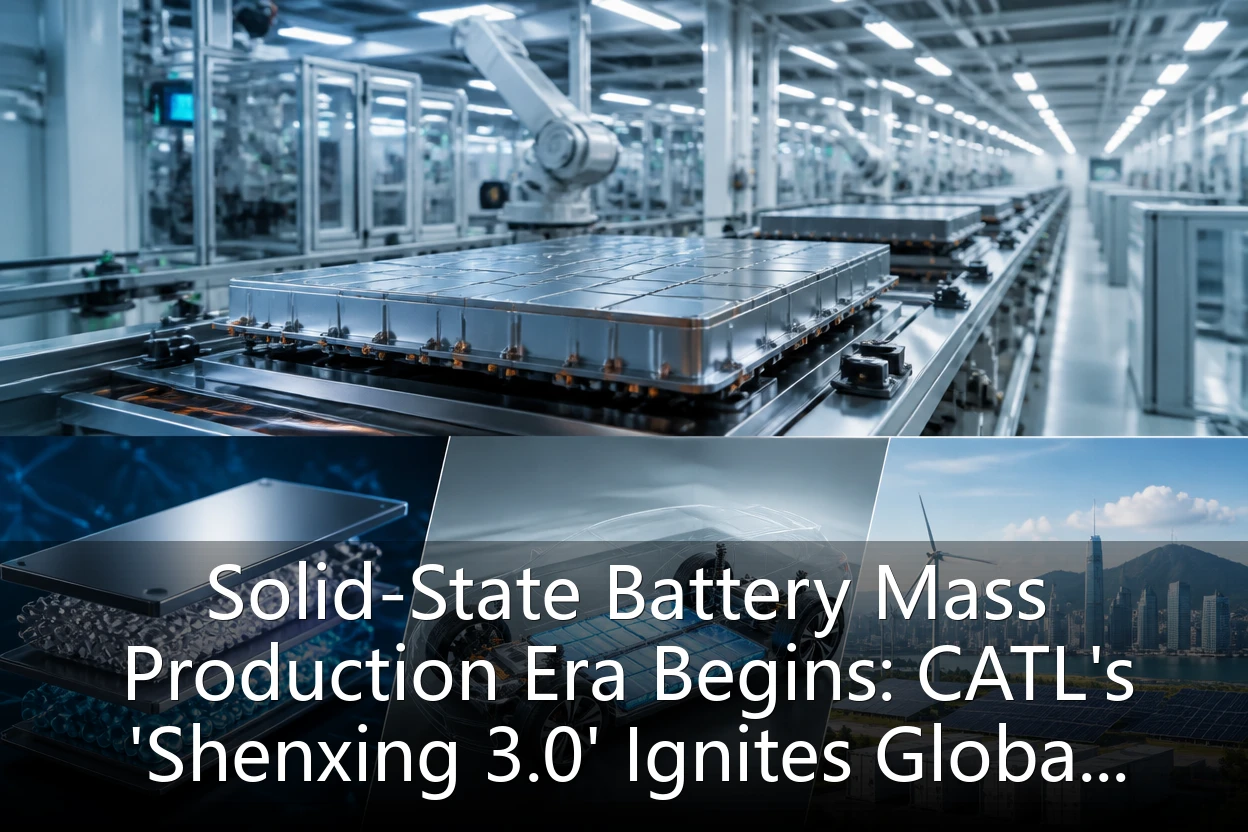
In early August 2026, the global new energy industry chain was ignited by a bombshell announcement. CATL officially declared via an online launch event that its first 50GWh all-solid-state battery mass production line had been powered on and commenced production at its Fujian Ningde base. The first batch of 'Shenxing 3.0' solid-state battery packs will be delivered to leading global NEV manufacturers in Q4 this year. This marks the largest technological leap since the invention of the lithium battery—solid-state batteries have officially moved from the laboratory to commercial mass production.
As a financial observer focused on trend foresight, Huagang Insights believes this is not a simple product iteration but a profound industry reshuffle. The mass production of solid-state batteries will not only completely resolve the 'range anxiety' and 'safety pain points' that have plagued new energy vehicles for a decade but will also reshape the valuation system of the global power battery and even the entire new materials industry. For the Hong Kong stock market, upstream and downstream enterprises in the industrial chain that have proactively laid out solid-state electrolytes, novel anode materials, and high-precision stacking equipment are facing an unprecedented Davis Double-Click opportunity.
I. Technological Breakthrough: Why Are Solid-State Batteries Called the 'Endgame'?
To understand the disruptive nature of this mass production, we must first review the physical bottlenecks of traditional liquid lithium batteries. The current mainstream liquid lithium batteries generally have an energy density between 250-300Wh/kg, approaching their theoretical limit. Meanwhile, the liquid electrolyte is flammable and volatile, posing a thermal runaway risk under extreme conditions like collision or overcharging. This leads to pain points for new energy vehicles, such as reduced winter range, rapid power drain at high speeds, and charging times still unable to match those of gasoline vehicles.
Solid-state batteries achieve two major leaps by replacing the liquid electrolyte with a solid-state electrolyte (such as oxides, sulfides, or polymers) and allowing the use of metallic lithium as the anode:
- Energy Density Leap: CATL's 'Shenxing 3.0' achieves an energy density exceeding 450Wh/kg, meaning that for the same weight, an EV's range can easily surpass 1,000 kilometers, even advancing towards 1,200 kilometers.
- Ultimate Safety and Wide Temperature Range: The solid-state electrolyte is non-flammable and maintains excellent ionic conductivity from -30°C to 80°C, completely ending the awkward situation of 'winter range dropping drastically'.
The commissioning of this mass production line signifies that CATL has successfully overcome three major hurdles: high interfacial impedance of solid electrolytes, poor solid-solid interface contact, and low yield rates in large-scale preparation. This has pulled the industry's previously expected 'solid-state mass production year' forward from 2027 to 2026.
II. Industry Chain Restructuring: Which Segments Will Boom? Which Face Elimination?
A shift in technological pathways is often accompanied by the decline of old forces and the rise of new champions. The mass production of solid-state batteries is reshaping the global supply chain worth hundreds of billions of dollars.
1. Core Incremental Segments: Solid-State Electrolytes and Novel Anodes
The solid-state electrolyte is the soul of the solid-state battery, accounting for over 40% of the cell cost. Currently, CATL primarily adopts the sulfide route, which offers extremely high ionic conductivity but is prone to moisture absorption and oxidation, placing extremely high demands on humidity control and sealing materials in the production environment. In the Hong Kong stock market, companies with mass production capabilities for lithium sulfide precursors, as well as ceramics and chemical firms providing high-purity inorganic non-metallic powder materials, will become the primary targets for capital accumulation.
Furthermore, the transition from silicon-based anodes to metallic lithium anodes will accelerate. Traditional graphite anode suppliers that fail to transform in time will face the risk of capacity clearance; while companies mastering ultra-thin metallic lithium strip preparation processes will enjoy significant premiums.
2. Manufacturing Equipment Iteration: From Winding to Stacking, From Filling to Pressing
As solid-state batteries no longer require the electrolyte filling process, demand for traditional filling machines and formation cabinets will plummet. They will be replaced by high-pressure roller presses, vacuum drying equipment, and ultra-precision stacking machines. The equipment replacement cycle has been forcibly initiated, and Hong Kong-listed lithium battery equipment leaders with turnkey line delivery capabilities have order visibility extending to 2028.
3. Separators and Electrolytes: The Transformation Pain of Sunset Industries
The substitution of traditional separators and electrolytes by solid-state batteries is fatal. Although semi-solid-state transition solutions may temporarily retain small amounts of separators and electrolytes in the short term, in the long run, these two major industries will inevitably shrink. Related listed companies must urgently seek a second growth curve, or they will face a double kill of valuation and performance.
III. Hong Kong Stock Market Outlook: 'Separating the Wheat from the Chaff' and Investment Themes in the New Energy Sector
Looking back over the past three years, the Hong Kong-listed new energy sector has experienced a full cycle from bubble expansion to valuation correction. With the landing of the substantial positive catalyst of solid-state battery mass production, the sector's trend will shift from 'speculating on concepts' to 'competing on delivery'. Huagang Zhiwei believes that in the next six months, the Hong Kong-listed new energy industry chain will present the following three major investment themes:
Theme 1: The 'Davis Double-Click' for Core Material Suppliers
As production capacity ramps up, the performance of core solid-state battery material suppliers will experience explosive growth in 2027. The current market valuation of these enterprises still follows the logic of traditional materials. Once financial reports show a significant increase in solid-state-related revenue share, their PE center will be repriced. Focus on niche material leaders listed in Hong Kong that have already entered the solid-state supply chains of CATL or BYD.
Theme 2: The 'Picks and Shovels' Logic in Equipment
Regardless of which battery manufacturer ultimately wins in the solid-state era, equipment investment is upfront and rigid. Hong Kong-listed equipment enterprises with the capability for complete solid-state battery production line planning and abundant orders on hand have the highest performance certainty. These enterprises are expected to see a resonance of orders and performance from the second half of 2026 into 2027.
Theme 3: The 'Reshaping of the Landscape' for Automakers
The high initial cost of solid-state batteries (expected to be 2-3 times that of liquid batteries) means they will first be deployed in high-end luxury models. Hong Kong-listed automakers with premium brand genes and deep partnerships with battery manufacturers are expected to reshape their brand power by launching the first solid-state models in 2026-2027, seizing high-end market share; while mid-to-low-end automakers lacking differentiated competitiveness will see their survival space further compressed.
Conclusion: Navigating the Technology Cycle, Seizing the Certainty Premium
The commissioning of CATL's solid-state battery production line is like dropping a boulder into a calm lake, with ripple effects that will profoundly change the global manufacturing landscape in the coming years. From a trend foresight perspective, solid-state batteries are not only the endgame solution for new energy vehicles but also the foundational infrastructure for future high-energy-consumption, high-safety-requirement scenarios like low-altitude economy (eVTOL) and humanoid robots.
For investors facing this definitive industrial trend, they should abandon short-term speculative thinking, deeply study the industrial chain map, and seek hidden champions with deep technological moats in the materials and equipment segments. In this uncertain macro environment, the technological revolution brought by solid-state batteries represents the certainty premium we must firmly grasp.