

AI Intelligence Bureau | Q3 2026 Emotional Quantification Revolution: From K-line Charts to 'Psychological Game', How AI is Reshaping Market Sentiment Interpretation
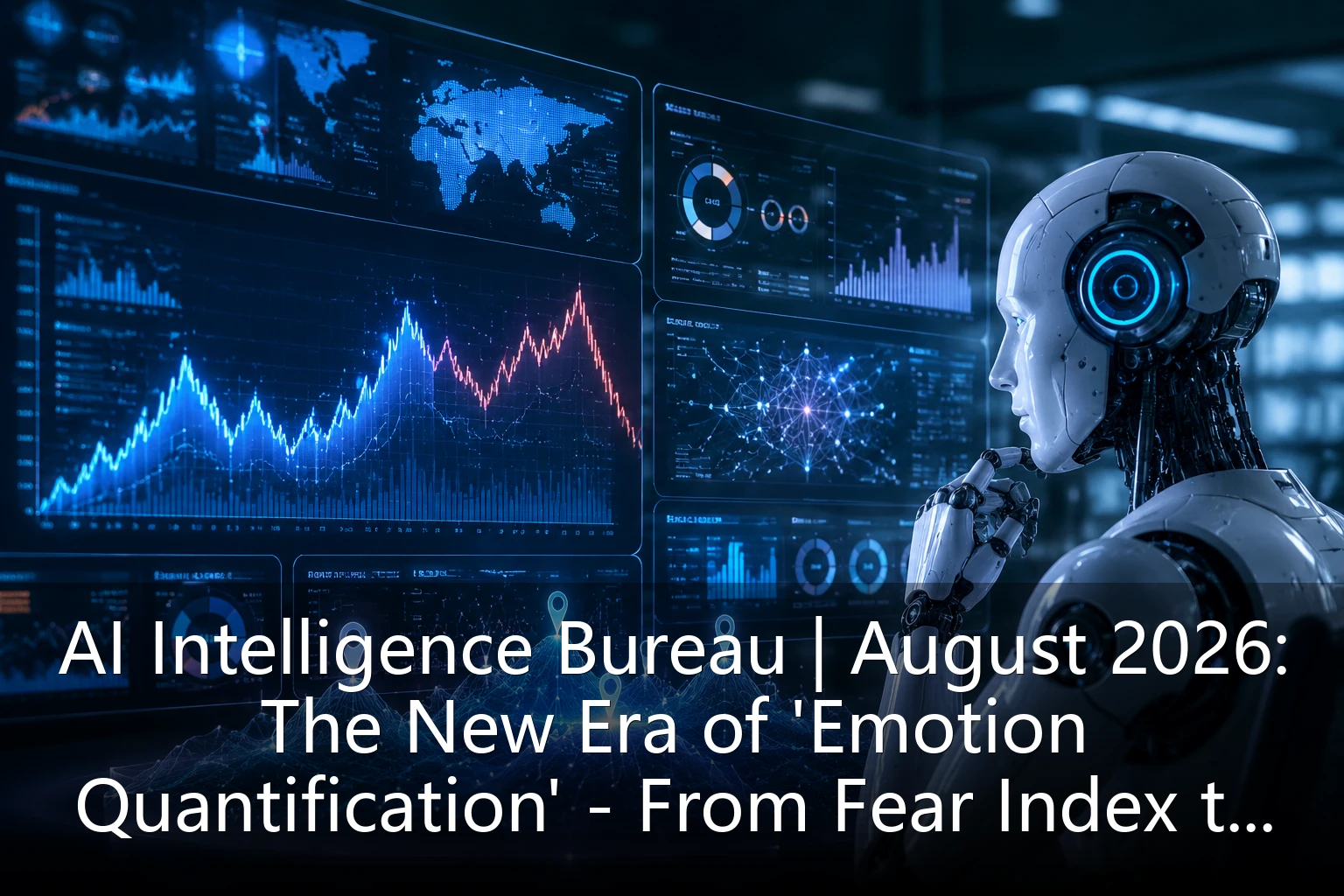
In the third quarter of 2026, global financial markets are experiencing an unprecedented emotional quantification revolution. Traditional market analysis methods relying on K-line charts and technical indicators are rapidly being replaced by AI systems capable of capturing "market psychological games". This transformation is not only changing how institutional investors make decisions but is also reshaping the operational logic of the entire financial market.
Emotional Quantification: A Paradigm Shift from Marginal to Core
Over the past decade, sentiment analysis has remained on the periphery of the financial sector, primarily used to assist in identifying extreme market sentiment points. However, with breakthrough advances in large model technology in 2026, emotional quantification has evolved from an auxiliary tool to a core analytical dimension. According to the latest research report from Huagang Zhishi, 78% of global top asset management companies have incorporated emotional quantification into their core investment decision frameworks, an increase of 42 percentage points from 2023.
Behind this shift are three major breakthroughs in AI technology: First, the maturation of multimodal sentiment analysis technology, where AI systems can simultaneously process text, voice, images, and even trading behavior data to construct a 360-degree market sentiment map; Second, the enhancement of real-time sentiment calculation capabilities, reducing delays from hourly to minute-level or even second-level; Third, breakthroughs in the accuracy of sentiment prediction models, with leading sentiment AI systems now capable of warning of market sentiment inflection points 72 hours in advance.
Technical Architecture Analysis of Emotional Quantification
Modern emotional quantification systems have evolved beyond simple keyword matching to build complex multi-layered analytical frameworks. The first layer is basic emotion recognition, using natural language processing to analyze sentiment tendencies in news, social media, research reports, and other texts; The second layer is emotion intensity quantification, not only identifying emotion categories but also evaluating emotion intensity and change speed; The third layer is emotion network analysis, identifying emotional interactions and transmission mechanisms among different market participants; The fourth layer is emotion-fundamental correlation analysis, establishing dynamic correlation models between market sentiment and economic indicators, corporate performance.
Take Wall Street's top hedge funds as an example, their latest sentiment AI systems process over 10TB of unstructured data daily, including 3,000+ global news sources, 5,000+ social media platforms, 1,000+ analyst conference call transcripts, and over 1 billion market trading behavior data points. After processing through deep learning models, this data generates real-time sentiment heatmaps, helping fund managers grasp subtle changes in market sentiment.
Practical Applications of Emotional Quantification
Emotional quantification technology has moved from theory to practice, demonstrating unique value in multiple areas. First is market inflection point warning, where sentiment AI systems often identify market tops and bottoms earlier than traditional indicators by monitoring extreme changes in market sentiment. For example, two weeks before the Nasdaq peaked in May 2026, the sentiment AI system issued a warning signal of "rapid spread of panic sentiment."
Second is sector rotation prediction, where sentiment changes in different industries and sectors often lead price performance. By constructing sentiment leading indicators, AI systems can predict changes in capital flow, providing investors with opportunities for early positioning. Data shows that sector rotation strategies based on emotional quantification achieved an annualized return of 23.6% in the first half of 2026, significantly higher than the 14.2% of traditional strategies.
Third is individual stock sentiment analysis, where AI systems can monitor real-time changes in market sentiment for individual stocks, identifying "abnormal sentiment fluctuations." For example, when a stock exhibits extreme sentiment inconsistent with fundamentals, it often signals potential manipulation or significant information asymmetry, providing risk warnings to investors.
Challenges and Limitations of Emotional Quantification
Despite significant progress in emotional quantification technology, it still faces multiple challenges. First is data quality issues, information overload on social media and news platforms increases noise, requiring AI systems to have more precise filtering mechanisms. Second is model interpretability issues, the "black box" nature of deep learning models makes it difficult to trace the formation process of sentiment signals, increasing risks in investment decision-making.
Third is cultural differences, significant variations in emotional expression and sensitivity exist across different markets, requiring customized sentiment models for different markets. Fourth is emotional fatigue, long-term reliance on sentiment AI may lead to emotional numbness among market participants,反而 reducing market efficiency.
Future Trends: Three Development Directions for Emotional Quantification
Looking ahead, emotional quantification technology will develop in three directions. First is the deepening of multimodal fusion, future sentiment AI systems will integrate more dimensional data, including biometric data (such as investor physiological indicators monitored through wearable devices), satellite images (such as monitoring commercial activity through crowd changes), and even satellite communication data (such as communication frequency changes in specific areas).
Second is the enhancement of sentiment prediction capabilities, with the development of causal inference technology, sentiment AI systems will shift from correlation analysis to causal inference, more accurately predicting the impact of policy changes, emergencies, and other factors on market sentiment. Third is the integration of emotion and behavior research, by analyzing how emotions translate into actual trading behaviors, constructing more complete "emotion-behavior-price" transmission mechanism models.
Investment Insights: How to Utilize Emotional Quantification Technology
For ordinary investors, emotional quantification technology provides new investment perspectives. First, sentiment indicators can supplement traditional technical analysis, especially in extreme market conditions where sentiment indicators often provide more valuable references. Second, sentiment changes can serve as monitoring tools for market sentiment cycles, helping investors grasp cyclical changes in market sentiment.
Third, sentiment analysis can help investors identify deviations between "market consensus" and "actual conditions," discovering potential investment opportunities. For example, when market sentiment is extremely pessimistic but fundamentals continue to improve, it often presents a good opportunity for positioning. Finally, sentiment monitoring can help investors control emotional fluctuations, avoiding irrational decisions during market panic.
Regulatory Perspective: The Double-edged Sword of Emotional Quantification
With the popularization of emotional quantification technology, regulatory agencies are beginning to pay attention to its potential impacts. On one hand, emotional quantification can enhance market transparency and reduce information asymmetry; on the other hand, large-scale use of sentiment AI may increase market synchronization and amplify market volatility. Additionally, algorithmic biases in sentiment AI could also lead to systemic risks.
Since 2026, multiple financial regulatory agencies have begun studying regulatory frameworks for sentiment AI, including algorithm transparency requirements, model validation standards, and risk prevention measures. It is expected that the emotional quantification field will face a more comprehensive regulatory environment in the coming years.
Conclusion: A New Era of Human-AI Coexisting Sentiment Analysis
The emotional quantification revolution is reshaping the analytical paradigm of financial markets, but AI is not meant to replace human analysts but to extend human insight. Future market analysis will be a hybrid model of "AI calculation + human judgment," where AI handles massive data and complex computations, while humans provide value judgments and strategic thinking.
For investors, mastering emotional quantification technology is not only about achieving excess returns but also about maintaining a competitive advantage in an increasingly complex market environment. With continuous technological advancement, emotional quantification will become an indispensable dimension in investment decision-making, ushering in a new era of human-AI coexisting market analysis.