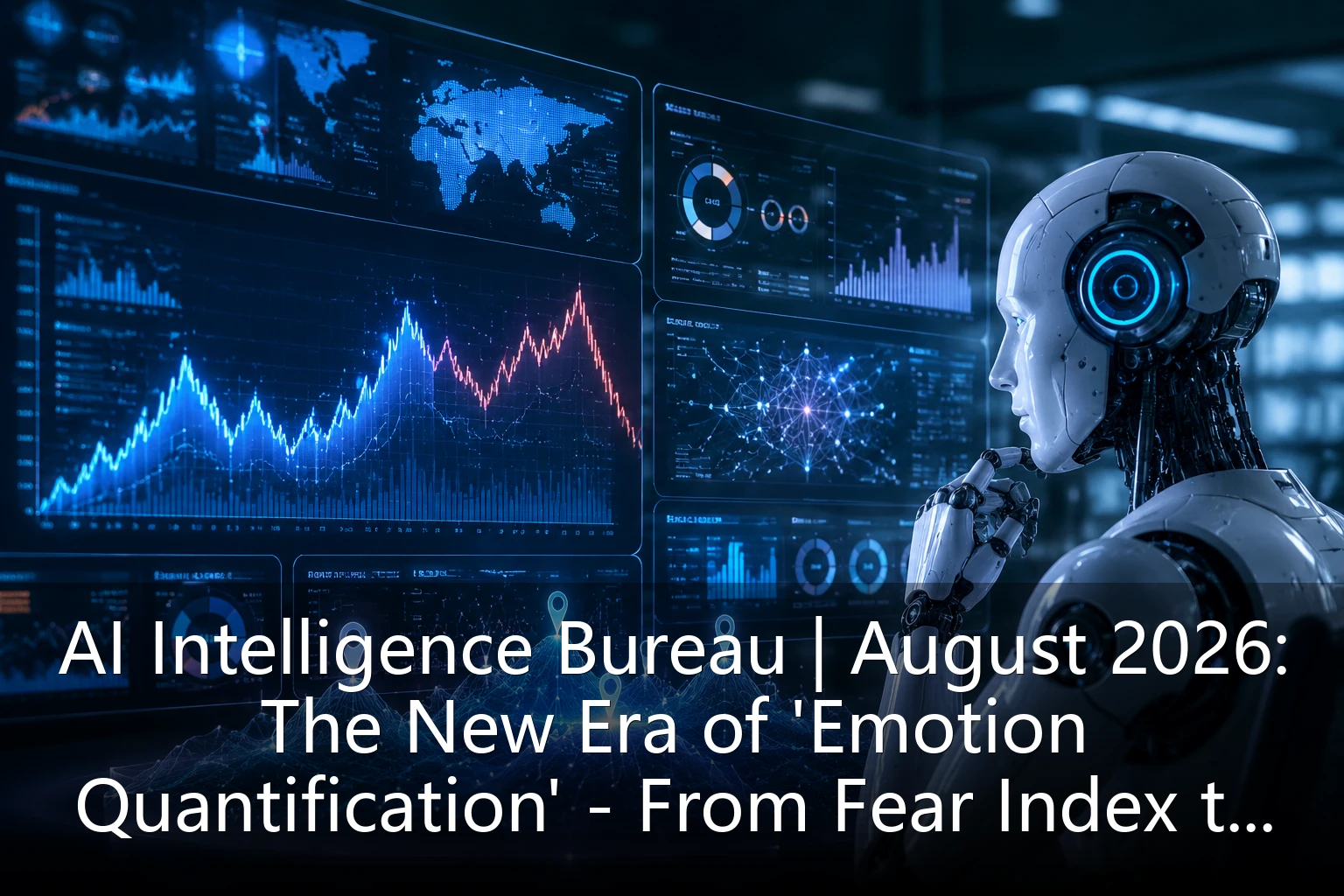


August 1, 2026, New York — While global investors were still debating the Fed's rate path and tech stock valuations, a new AI sentiment analysis platform named SentinelMind quietly launched, claiming it can parse massive unstructured data in real time via large language models (LLMs) to predict sentiment turning points in the U.S. stock market 72 hours ahead. The news quickly sparked heated discussions in quant trading circles and the asset management industry.
From "Lagging Indicator" to "Forward Radar": A Paradigm Shift in Sentiment Analysis
Traditional market sentiment indicators, such as the VIX, put/call ratios, and retail investor surveys, are mostly based on prices, options positions, or questionnaire data, with a clear lag—by the time the indicator flashes, the market has often already reacted. SentinelMind's team says they leverage LLMs' unique semantic understanding and contextual reasoning to upgrade sentiment analysis granularity from "daily" to "minute-level," expanding coverage to press releases, Twitter posts, Reddit discussions, and transcribed earnings call recordings of listed companies.
The platform's core is a fine-tuned financial LLM trained to identify sentiment-laden expressions and distinguish "factual statements" from "opinion expressions." For example, when a CEO says "we face severe macroeconomic headwinds" on an earnings call, the model not only captures the negative sentiment but also assesses the potential impact on the stock price via attention mechanisms, taking into account current economic data and peer company comments.
The 72-Hour "Early Warning": How It Works and Real-World Tests
SentinelMind's early warning mechanism is not a single model output but a multi-agent collaborative system. Three AI agents with distinct roles handle: real-time data scraping and cleaning (Spider Agent), deep semantic sentiment scoring (Mood Agent), and cross-time trend prediction (Trend Agent). The system ultimately generates a 0-100 "Market Fear-Greed Index" and triggers alerts when the score breaches historical extremes.
According to the official technical whitepaper, in a backtest in July 2026, the index successfully warned of the Nasdaq's 2.3% intraday plunge on July 15 with 72 hours' advance notice. Earlier that day, the model detected tech executives repeatedly using terms like "inventory correction" and "weak demand" on social media, with unusually fast spread of related discussions. In contrast, the VIX did not jump significantly until the market opened that day.
Industry Perspective: AI Is Reshaping the Rules of "Information Arbitrage"
For professional asset managers, sentiment analysis is nothing new, but past methods based on dictionaries or machine learning classifiers struggled with complex contexts such as irony, metaphor, or industry jargon. The breakthrough of LLMs is that they truly "understand" human expression. A senior strategist at Charles Schwab noted in a research brief: "When AI can read The Wall Street Journal and company quarterly reports like a seasoned trader and distill market consensus optimism or pessimism, traditional information advantages will be quickly eroded."
More notably, such tools could alter market microstructure. As more institutions adopt AI sentiment alert systems, algorithms may form positive feedback loops: once an AI signal triggers selling, other AIs follow suit, amplifying volatility. This "machine herding effect" was already visible in the 2024 U.S. stock flash crash and may become more common in the future.
Lessons for Retail Investors: Use AI to Arm Your Mind, Not to Blindly Follow
For average retail investors, such professional-grade tools may be out of reach, but the methodology behind them is worth learning.
- Watch for semantic shifts: Don't just stare at the numbers in financial reports; pay attention to management's tone and wording on earnings calls. For example, the difference between "we are satisfied" and "we are pleasantly surprised" often hides signs of better-than-expected performance.
- Use free alternatives: Some free AI sentiment analysis plugins already exist, such as a ChatGPT-based Twitter sentiment scanner. Though less accurate than professional platforms, they can help investors train sensitivity to market sentiment shifts.
- Think in reverse: When the AI sentiment index shows extreme greed or fear, ask yourself "Has this signal already been priced in by the market?" Because once everyone sees the warning, the warning itself may fail.
Regulation and Risk: AI Sentiment Models Are Not a Magic Crystal Ball
Despite the enticing technological prospects, regulators are wary of abuse of AI prediction models. In 2025, the U.S. Securities and Exchange Commission (SEC) fined two companies for using AI to generate misleading investment analysis reports. Analysts point out that tools like SentinelMind are still essentially probabilistic models; their training data inherently carries historical bias, and they cannot predict "black swan" events—such as sudden geopolitical conflicts or unexpected central bank policy shifts.
Moreover, LLMs' performance in extreme market conditions remains insufficiently tested. A May 2026 academic paper noted that during panic selling, AI sentiment indicators often fail due to the scarcity of "similar scenarios" in training data, and may even overlook critical signals of liquidity drying up. Therefore, any AI early warning system should be regarded as a decision-support tool, not a "holy grail" replacing human judgment.
Future Outlook: Where Is AI Sentiment Analysis Headed?
With the evolution of multimodal LLMs, the next generation of sentiment analysis tools will go beyond text, simultaneously parsing analysts' tone, facial expressions, and even port congestion in satellite images, building a more three-dimensional market picture. Meanwhile, trading strategies based on AI sentiment indicators will gradually evolve under the regulatory framework, from simple threshold triggers to dynamic adjustment strategies combined with macroeconomic models.
But as one quant fund manager put it: "AI can capture the market's emotions, but cannot sense its own—and that is precisely the double-edged sword." In an algorithm-driven era, maintaining understanding and respect for human nature may be investors' true moat.