

AI Cycle Confirmed Again: The Industry Logic Behind the Broad Surge in Memory Chips
Keywords: Micron, memory chips, artificial intelligence, guidance, semiconductor cycle, tech stocks, data centers
Introduction
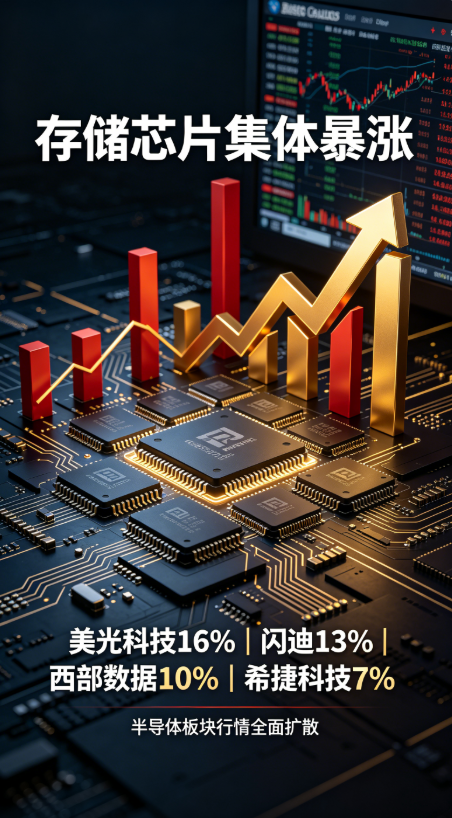
Before the U.S. market open, memory-chip stocks rose together, with Micron jumping more than 16% in a single day. SanDisk, Western Digital, Seagate Technology and others also surged sharply. This rally was not simply a sentiment rebound; it was ignited by Micron’s significantly better-than-expected guidance. More importantly, the outlook once again strengthened market confidence in the AI investment cycle and helped support tech stocks, which had shown signs of fatigue recently.
Beating Expectations, the AI Narrative Heats Up Again
Micron’s latest earnings signal delivers a clear conclusion: AI-driven memory demand has not weakened; instead, it is still in a phase of accelerated expansion. As AI model training and inference continue to drive up demand for high-bandwidth memory, advanced memory and data center infrastructure, the memory-chip industry is shifting from a traditional cyclical recovery toward a more structural growth story.
Qualcomm’s simultaneous sales outlook sent the market a similar signal. In particular, amid intensifying competition in data center infrastructure, more and more chip companies are trying to capture a larger share of the AI capital-spending wave. That means the current rebound in semiconductors is not an isolated event, but the result of resonance across multiple links in the industrial chain.
From De-Stocking to Supply-Demand Reshaping
Looking back at 2023, the memory industry was still mired in excess inventory and weak demand, and Micron even posted losses of nearly $6 billion in one fiscal year. At that time, few expected that little more than a year later, these companies would become the focus of capital markets.
The memory-chip industry is unique in that it is highly dependent on capital investment and is also very vulnerable to supply-demand mismatches, so it has long shown violent boom-and-bust cycles. But the rise of AI is changing that old pattern. Unlike demand centered on smartphones and PCs, AI data centers require greater capacity, speed and stability from memory, and purchasing is more long term, making industry conditions more resilient.
Micron CEO Sanjay Mehrotra’s comments are highly representative: with the rapid spread of AI, the memory industry has already undergone a structural transformation, and the current stage is only the early phase of that process. That means the market’s pricing logic for memory chips may be shifting from a "cyclical bottom repair" to a "long-term AI-driven revaluation."
Global Resonance, Tech Sentiment Repaired
This wave of optimism has not been limited to the U.S. market. Benchmark indexes in Asia also rose in sync, with South Korea’s SK Hynix and Samsung Electronics posting strong gains; Europe’s technology sector also clearly outperformed the broader market. Meanwhile in Japan, Kioxia has benefited from AI demand in its flash-memory business, and its share price has risen by nearly 800% in total, even making it one of Japan’s most valuable companies.
This shows that AI’s boost to the memory industry has spread from the level of individual companies to the global industrial chain. For investors, the key is not just whether one company’s results are strong, but whether AI capital spending is still in an upward cycle. For now, the statements from Micron and Qualcomm both suggest that this cycle is far from over.
Conclusion
The collective surge in memory chips is essentially the market’s renewed confirmation of the AI industry trend. Micron’s strong guidance not only lifted tech sentiment, but also reminded investors of the long-term growth potential created by artificial intelligence. Although the semiconductor industry has always been highly volatile, under the backdrop of continued expansion in AI infrastructure, memory chips are shifting from cyclical assets to structural beneficiaries.
Going forward, as data center investment continues to accelerate, the revenue and profit elasticity of related companies is expected to expand further. For capital markets, this AI-driven memory rally may only now be entering a deeper stage of development.