

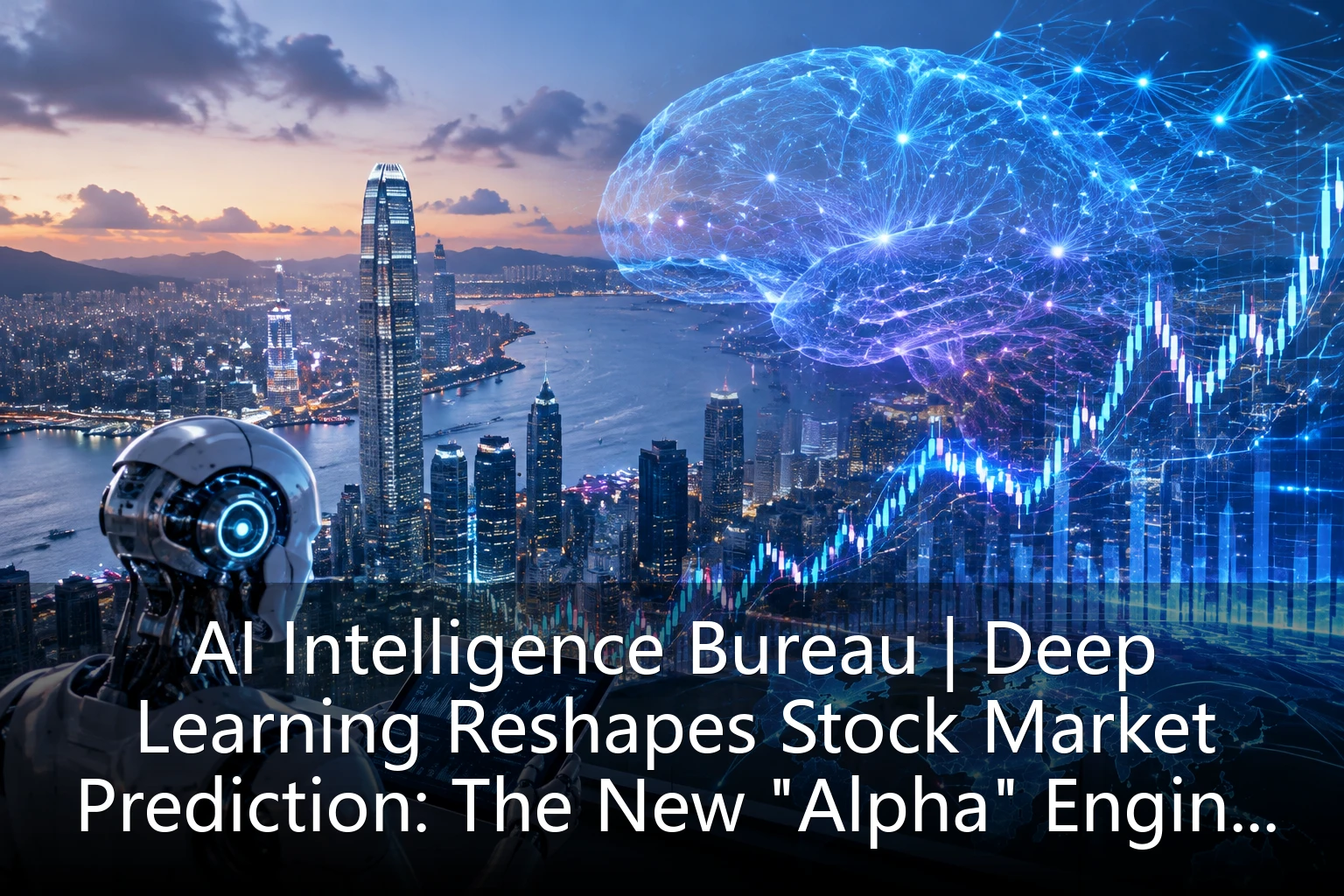
August 14, 2026, global financial markets are undergoing a silent yet magnificent technological revolution. In the trading halls of Hong Kong and A-shares, although the noise remains, the "brain" truly determining capital flows is no longer traditional human traders, nor even simple linear regression models. With the marginal decrease in computing costs and iterative upgrades of algorithm architectures, Deep Learning has officially moved from the laboratory to the trading front desk, becoming the new engine for quantitative investment to mine excess returns (Alpha).
Paradigm Shift from a "Linear World" to a "Nonlinear Universe"
For a long time, traditional quantitative investment relied on multi-factor models, building strategies by finding linear correlations between price, volume, and macroeconomic indicators. However, financial markets are essentially complex, nonlinear dynamic systems, full of chaos and sudden shocks. Traditional statistical learning methods often appear inadequate when processing this high-dimensional, unstructured data.
Entering 2026, the proliferation of deep learning technology has completely changed this situation. Deep learning models based on artificial neural networks, especially variants of the Transformer architecture, have demonstrated amazing feature extraction capabilities. Unlike traditional models that require manually defined factors, deep learning models can automatically learn potential complex patterns from massive raw data.
Taking the Hong Kong stock market as an example, due to the influence of multiple factors such as exchange rate fluctuations, Federal Reserve policies, and mainland economic fundamentals, the volatility logic of Hong Kong stocks is extremely complex. The latest market data for 2026 shows that quantitative funds driven by deep learning perform significantly better than traditional multi-factor strategies in balancing the capture of short-term reversals and long-term trends in the Hong Kong stock market. The core of this advantage lies in the deep model's ability to "understand" complex nonlinear interaction relationships between factors. For example, between market panic (soaring VIX index) and liquidity drying up in specific sectors, there often exists a nonlinear mapping that traditional models cannot capture.
The Gold Mine of Unstructured Data: NLP Reshaping Investment Research Logic
The most disruptive application of deep learning in stock market prediction is undoubtedly its ability to process unstructured data. In 2026, unstructured data such as text, images, and audio accounts for more than 90% of the total information in financial markets.
Natural Language Processing (NLP), as an important branch of deep learning, is reshaping investment research logic. In the past, analysts needed to read thousands of financial reports, news research reports, and social media posts word for word, which was not only inefficient but also prone to subjective emotional influence. Today, NLP systems based on Large Language Models (LLMs) can crawl global internet information in real-time, perform sentiment analysis on central bank meeting minutes, and even analyze traffic flow in Walmart parking lots from satellite images to predict retail revenue.
- Sentiment Quantification: The system can convert financial news and social media discussions into real-time "sentiment factors". In the A-share market, retail investor sentiment has a huge impact on short-term stock price fluctuations. By analyzing text data from platforms like stock forums and Weibo, deep learning models can capture inflection points in market sentiment faster than traditional data.
- Knowledge Graph Construction: Utilizing Graph Neural Networks (GNNs), AI can build relationship graphs of upstream and downstream industrial chains. When a listed company issues a profit warning, the model can quickly locate its upstream and downstream partners through the knowledge graph and predict the chain reaction on related stocks. This reasoning capability is difficult for traditional quantitative models to achieve.
Multimodal Fusion: Seeing the Invisible Signals
Another significant trend in 2026 is the rise of multimodal deep learning models. Single text or price data can no longer meet the needs of top-tier institutions. Leading quantitative funds have begun to integrate text, time-series data, macroeconomic data, and even alternative data (such as credit card consumption records and geolocation data) to build a unified multimodal input layer.
For example, when analyzing a new energy vehicle company, the model inputs not only its historical stock prices and financial statements (structured data) but also the sentiment of recent related news reports (text data) and usage frequency charts of charging piles in major cities (image data). Through the fusion layer of the deep neural network, these heterogeneous data are converted into unified feature vectors, thereby achieving more accurate prediction of stock prices. This all-encompassing "God's eye view" gives deep learning models stronger robustness when dealing with market black swan events.
The "Black Box" Dilemma and the Rise of Explainable AI (XAI)
Although deep learning has repeatedly hit new highs in prediction accuracy, its "black box" nature has always been a major concern for institutional investors, especially risk control departments. If a decision resulting in hundreds of millions of dollars in losses is made by an unexplainable neural network, it is difficult to gain the full trust of management regardless of its past performance.
In 2026, with regulatory bodies (such as the implementation of the EU's "AI Liability Act") increasing requirements for algorithm transparency, Explainable Artificial Intelligence (XAI) has become a battleground in the quantitative field. The market no longer only focuses on "what the prediction is", but more on "why the prediction is so".
Currently, mainstream solutions in the industry include SHAP value analysis and attention mechanism visualization. Through these technologies, traders can intuitively see how much weight the model assigns to "expectations of central bank interest rate cuts" and "technical oversold conditions" in a specific bullish decision. This improvement in transparency not only enhances the effectiveness of risk control but also makes deep learning models more easily accepted by human fund managers, forming a new "human-in-the-loop" investment decision-making model.
Differentiated Application Prospects for Hong Kong Stocks and A-Shares
The application of deep learning technology in the Hong Kong and A-share markets presents interesting differentiated characteristics, mainly stemming from the fundamental differences in the structure of the two markets.
In the A-share market, due to the high proportion of retail investors, the market exhibits obvious "herd behavior" and emotional trading characteristics. The advantage of deep learning models in A-shares is mainly reflected in high-frequency trading and sentiment capture. With millisecond-level data processing capabilities, AI can quickly identify the behavior of retail investors chasing highs and selling lows, and use tiny price fluctuations for arbitrage. In addition, the unique policy-driven market trends in A-shares also make policy interpretation models based on NLP shine in the A-share market.
In contrast, the Hong Kong stock market is dominated by institutional investors, with higher pricing efficiency and fewer pure arbitrage opportunities. Therefore, the application of deep learning in Hong Kong stocks focuses more on in-depth fundamental mining and macro risk hedging. For example, using deep learning models to analyze global supply chain data of multinational companies to predict their exchange gains and losses; or predicting global liquidity trends by analyzing changes in the tone of Federal Reserve officials' speeches, thereby adjusting positions in Hong Kong technology or property stocks.
Computing Power Arms Race and Algorithm Parity
It is worth noting that although deep learning has brought huge potential to quantitative investment, its high computing power costs once kept small and medium-sized private equity firms out. However, entering the second half of 2026, with the popularization of dedicated AI inference chips (ASICs) and the decline in cloud computing power leasing costs, the "arms race" at the algorithm level is shifting towards "algorithm parity".
This means that not only managers with billions in assets, but even small and medium-sized quantitative teams, have the ability to use the most advanced deep learning models for market analysis. This trend will greatly intensify market competition, forcing all participants to continuously iterate models to maintain a slim Alpha advantage. It is foreseeable that future market competition will no longer be a simple contest of capital scale, but a comprehensive game of data quality, algorithm architecture, and computing efficiency.
Conclusion: Embracing the New Normal of Investment in the Intelligent Era
Today in 2026, deep learning is no longer a concept in science fiction, but a reality that every investor must face. It is not only a technical tool but also a brand new way of thinking—the ability to insight into the essence from data and find order from chaos.
For investors in Hong Kong and A-shares, the application of deep learning in stock market prediction is both an opportunity and a challenge. It improves the market's pricing efficiency but also causes traditional technical analysis methods to gradually fail. In this data-driven era, only by maintaining an open mind, actively embracing AI technology, and perfectly combining human intuition with machine intelligence can one remain invincible in the treacherous capital market. Deep learning reshapes not only the model of stock market prediction but also the ecological landscape of the entire financial market.